AIIMS Bhopal Partners with Dutch Experts to Advance Personalised Medicine in India
AIIMS Bhopal has collaborated with Dutch experts to introduce personalized medicine approaches, aiming to improve patient outcomes through precision healthcare.
 Akanksha jain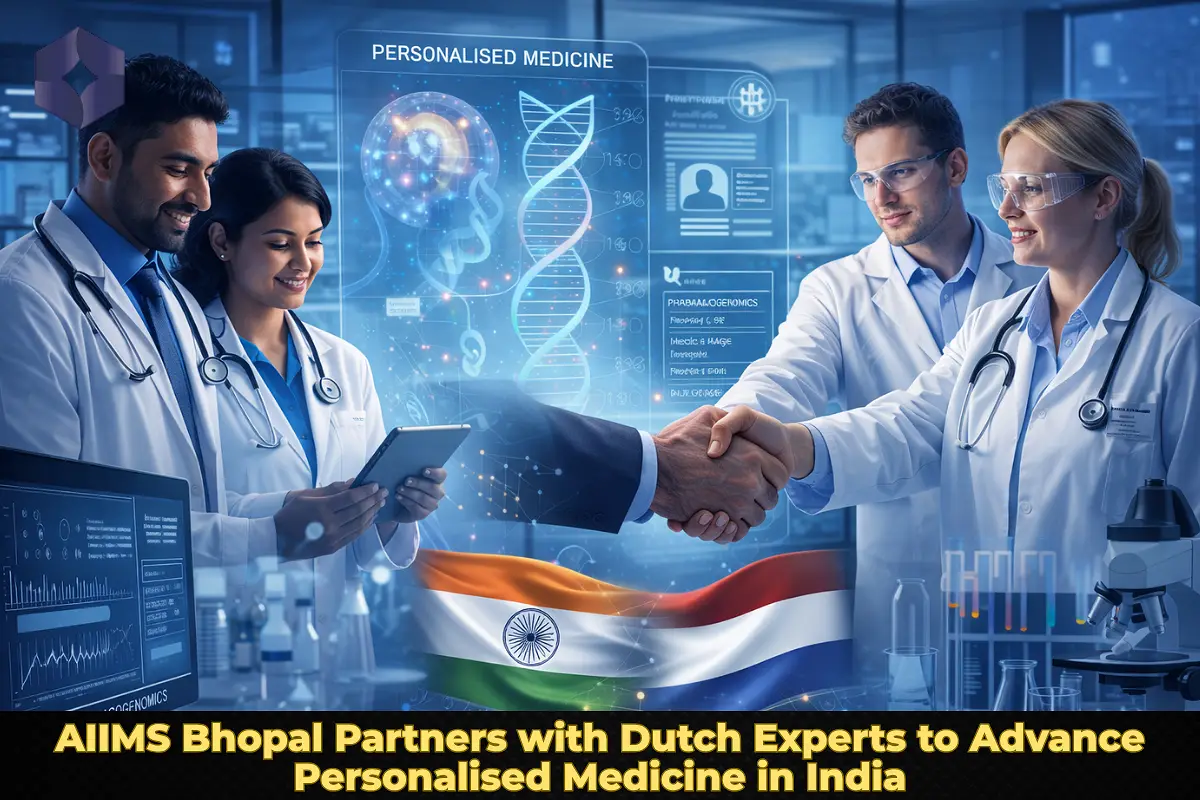
AIIMS Bhopal Partners with Dutch Experts to Advance Personalised Medicine in India
AIIMS Bhopal has partnered with a team of Dutch medical experts to introduce and expand personalized medicine approaches in India, officials announced in April 2026, aiming to enhance patient care by tailoring treatments based on individual genetic, environmental, and lifestyle factors.
The collaboration brings together clinicians, researchers, and scientists from India and the Netherlands to develop precision healthcare solutions, marking a significant step toward modernizing treatment protocols and improving outcomes for patients across a range of diseases.
Focus on Personalised Healthcare
Personalized medicine, also known as precision medicine, involves customizing medical treatment to the individual characteristics of each patient. This approach uses data such as genetic profiles, biomarkers, and clinical history to design targeted therapies that are more effective and have fewer side effects.
At AIIMS Bhopal, the initiative aims to integrate advanced diagnostic tools and genomic research into routine clinical practice. Experts believe this shift could significantly improve treatment success rates, particularly for complex and chronic conditions.
The collaboration is expected to facilitate knowledge exchange and capacity building in cutting-edge medical technologies.
Role of Dutch Expertise
The Dutch team brings experience in advanced genomics, data analytics, and precision healthcare systems, areas where European institutions have made significant progress. Their involvement is expected to accelerate the adoption of global best practices in India’s healthcare system.
Joint research programs, training sessions, and clinical studies are planned as part of the partnership. These efforts will focus on developing protocols that can be adapted to local healthcare needs while maintaining international standards.
Experts noted that such collaborations are essential for bridging gaps in expertise and resources.
Applications Across Diseases
The personalized medicine initiative is expected to benefit patients across multiple therapeutic areas, including oncology, cardiovascular diseases, and rare genetic disorders. In cancer treatment, for example, targeted therapies based on tumor genetics can significantly improve survival rates.
Similarly, in chronic diseases such as diabetes and heart conditions, personalized treatment plans can help optimize medication effectiveness and reduce complications. The approach also holds promise for early diagnosis and preventive care.
Researchers emphasized that tailoring treatments can lead to more efficient healthcare delivery.
Integration of Genomics and Technology
A key component of the collaboration is the integration of genomic sequencing and advanced data analytics into clinical workflows. By analyzing patients’ genetic information, doctors can identify specific risk factors and select therapies that are most likely to be effective.
Digital health technologies, including artificial intelligence and data-driven decision support systems, will play a crucial role in interpreting complex datasets. These tools can assist clinicians in making informed treatment decisions.
The initiative reflects a broader trend toward technology-driven healthcare innovation.
Capacity Building and Training
As part of the partnership, AIIMS Bhopal will focus on training healthcare professionals in personalized medicine techniques. Workshops, exchange programs, and collaborative research projects will help build a skilled workforce capable of implementing advanced medical practices.
Medical students and researchers are also expected to benefit from exposure to international expertise, enhancing their knowledge and career opportunities. Capacity building is seen as a critical factor in sustaining long-term progress.
Experts highlighted the importance of continuous education in adapting to evolving healthcare technologies.
Challenges in Implementation
Despite its potential, implementing personalized medicine in India presents challenges, including high costs, limited infrastructure, and the need for large-scale data management systems. Ensuring accessibility and affordability will be key to the success of such initiatives.
Ethical considerations, data privacy, and regulatory frameworks also need to be addressed as the use of genetic information becomes more widespread. Policymakers and healthcare providers must work together to create supportive environments for innovation.
Experts stressed that overcoming these barriers will require coordinated efforts across sectors.
Impact on India’s Healthcare System
The collaboration is expected to strengthen India’s position in the global healthcare landscape by promoting research and innovation. By adopting personalized medicine, healthcare providers can move toward more patient-centric care models.
Improved treatment outcomes, reduced healthcare costs in the long term, and enhanced disease prevention strategies are among the anticipated benefits. The initiative also aligns with India’s broader goals of advancing medical research and improving healthcare access.
Industry observers believe such partnerships can drive transformative change in the sector.
Global Collaboration in Healthcare
The partnership between AIIMS Bhopal and Dutch experts highlights the growing importance of international collaboration in addressing complex healthcare challenges. Sharing knowledge, technology, and expertise can accelerate the development of innovative solutions.
Global partnerships are increasingly seen as essential for tackling issues such as emerging diseases, aging populations, and the rising burden of chronic conditions. Collaborative efforts can lead to more effective and scalable healthcare strategies.
Experts noted that cross-border cooperation is key to advancing medical science.
Future Outlook
Looking ahead, the collaboration is expected to expand into additional research areas and clinical applications. Ongoing studies and pilot programs will provide insights into the effectiveness of personalized medicine approaches in the Indian context.
The success of this initiative could pave the way for similar partnerships across the country, further integrating precision medicine into India’s healthcare system. Continued investment in research and infrastructure will be essential for sustaining progress.
Stakeholders are optimistic about the long-term impact of the initiative.
Conclusion
The partnership between AIIMS Bhopal and Dutch experts marks a significant step toward advancing personalized medicine in India, with the potential to transform patient care through more precise and effective treatment approaches.