Andhra Pradesh Minister Slams Jagan’s ‘Mavigun Plan’ as Political Drama
Andhra Pradesh Agriculture Minister Atchannaidu criticizes Y.S. Jagan Mohan Reddy’s ‘Mavigun plan’ as political drama, intensifying tensions between ruling and opposition parties.
 SANJANA DUTTA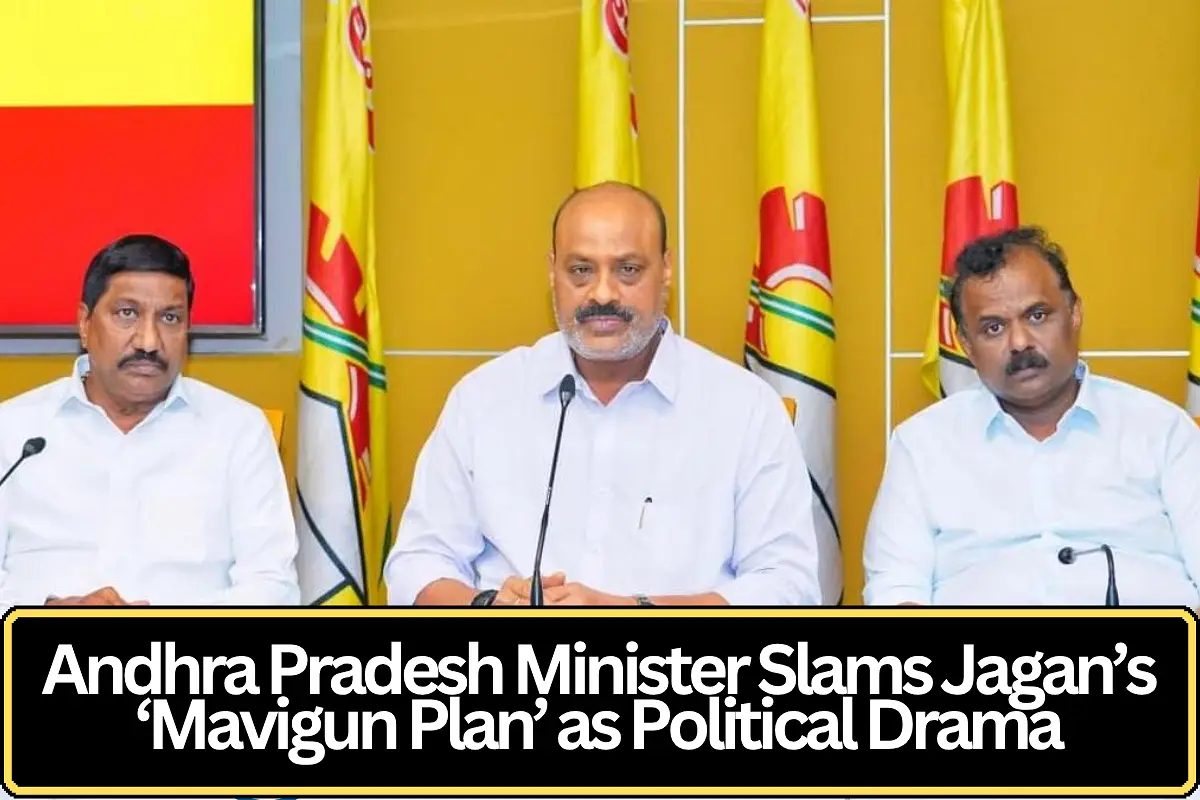
Minister Criticizes Opposition Proposal
VIJAYAWADA, April 4, 2026 — Andhra Pradesh Agriculture Minister K. Atchannaidu has sharply criticized former Chief Minister Y.S. Jagan Mohan Reddy’s proposed “Mavigun plan,” describing it as a political drama aimed at misleading the public, as tensions between the ruling government and the opposition intensify in the state.
The remarks come amid growing political exchanges between the ruling Telugu Desam Party (TDP) and the opposition Yuvajana Sramika Rythu Congress Party (YSRCP), with both sides accusing each other of failing to address key issues affecting farmers and rural communities.
Allegations of Political Motives
Atchannaidu alleged that the so-called “Mavigun plan” lacks substantive policy backing and is primarily intended to create political noise rather than deliver tangible benefits to the agricultural sector. He claimed that the proposal is part of a broader strategy by the opposition to regain public attention and rebuild its political base.
According to the minister, the state government has already implemented several initiatives to support farmers, improve irrigation infrastructure, and enhance crop productivity. He argued that the opposition’s criticism overlooks these efforts and attempts to distort the government’s record.
He further stated that any serious policy proposal must be grounded in practical considerations and supported by detailed planning, rather than being presented as a headline-grabbing initiative.
Opposition Defends Proposal
Leaders of the YSRCP, however, have defended the “Mavigun plan,” asserting that it represents a comprehensive approach to addressing challenges faced by farmers, including market access, input costs, and income stability. They have accused the ruling government of dismissing constructive ideas for political reasons.
Opposition representatives argue that the proposal is based on consultations with stakeholders and aims to introduce reforms that could benefit small and marginal farmers. They have called on the government to engage in meaningful dialogue rather than resorting to criticism.
The plan has been positioned by the opposition as part of its broader vision for agricultural development and rural welfare in the state.
Political Tensions Escalate
The exchange of statements marks the latest episode in an ongoing political rivalry between the TDP and YSRCP, which has intensified ahead of upcoming electoral cycles. Both parties have been actively seeking to consolidate support among key voter groups, particularly in rural areas.
Observers note that agriculture remains a critical issue in Andhra Pradesh, with political parties often framing their agendas around farmer welfare and rural development. As a result, policy proposals related to agriculture frequently become focal points of political debate.
The current controversy highlights the competitive nature of state politics, where both the ruling and opposition parties are keen to shape public perception and influence voter sentiment.
Focus on Agricultural Policies
The debate over the “Mavigun plan” has also brought renewed attention to the broader challenges facing the agricultural sector in Andhra Pradesh. Issues such as fluctuating crop prices, rising input costs, and climate-related uncertainties continue to affect farmers across the state.
Government officials have emphasized ongoing efforts to address these challenges through targeted schemes, including financial assistance, crop insurance, and infrastructure development. They have reiterated their commitment to strengthening the agricultural economy and ensuring sustainable growth.
At the same time, experts suggest that constructive engagement between political parties could help identify effective solutions and improve policy outcomes for farmers.
Public and Stakeholder Reactions
The political exchange has drawn mixed reactions from farmers’ groups, agricultural experts, and the general public. While some have welcomed the attention being given to agricultural issues, others have expressed concern over the politicization of policy discussions.
Stakeholders have called for greater transparency and collaboration in developing and implementing agricultural policies. They stress the importance of focusing on practical solutions that address ground realities rather than engaging in political rhetoric.
There are also calls for independent evaluation of policy proposals to assess their feasibility and potential impact.
Implications for State Politics
The controversy surrounding the “Mavigun plan” is likely to have broader implications for the political landscape in Andhra Pradesh. With both major parties positioning themselves as champions of farmer welfare, the debate could influence voter perceptions in rural constituencies.
Analysts suggest that the outcome of such debates may play a role in shaping electoral strategies and campaign narratives in the coming months. Political parties are expected to continue highlighting their respective approaches to agricultural development.
The issue also underscores the importance of effective communication and policy clarity in building public trust.
Call for Constructive Dialogue
Amid the escalating rhetoric, there have been calls from various quarters for a more constructive approach to political discourse. Experts and community leaders have urged both the government and the opposition to engage in dialogue and work towards consensus on key issues affecting farmers.
They emphasize that addressing the challenges faced by the agricultural sector requires coordinated efforts and a focus on long-term solutions. Collaborative policymaking, they argue, could lead to more sustainable and inclusive outcomes.
Such an approach could also help reduce political polarization and foster a more productive environment for governance.
Conclusion
The sharp criticism of Jagan’s “Mavigun plan” by the Andhra Pradesh Agriculture Minister has intensified political tensions in the state, highlighting the central role of agricultural policy in shaping political narratives.
Current Status
The debate continues, with both the ruling government and the opposition standing firm on their positions as discussions over agricultural policies and political strategies unfold.