Bulldozers on Bhoodan Lands in Telangana Spark Major Political Row
Demolition of hundreds of houses built on Bhoodan lands in Telangana’s Khammam district has triggered a political controversy, with opposition leaders accusing the government of targeting poor families while officials defend the action as legal.
 SANJANA DUTTA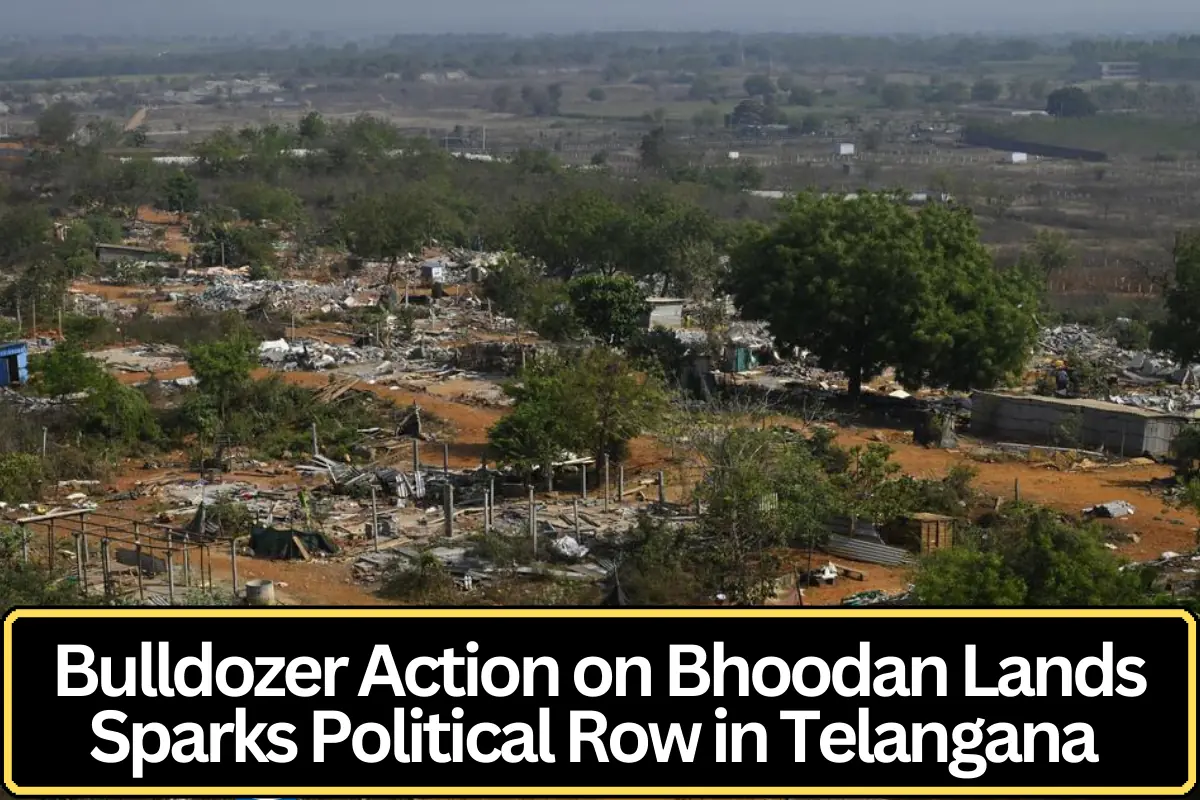
Demolition of Houses on Bhoodan Lands Triggers Political Controversy in Telangana
A major political controversy has erupted in Telangana following the demolition of hundreds of houses built on Bhoodan lands in Khammam district. The large-scale demolition drive carried out by district authorities has sparked protests from affected residents and criticism from opposition leaders, who claim that the government has targeted poor families living on land that was historically meant for the welfare of the landless.
The operation, which involved bulldozers, revenue officials, and a massive police deployment, cleared several acres of disputed land in the Velugumatla area near Khammam city. The action has ignited intense political debate across the state, with different parties offering sharply contrasting interpretations of the events.
While government officials maintain that the demolitions were necessary to reclaim illegally occupied land, critics argue that the action lacked compassion and raised serious concerns about the protection of vulnerable communities.
What Are Bhoodan Lands?
The controversy surrounding the demolitions is closely linked to the historical significance of Bhoodan lands. The Bhoodan movement was a land reform initiative launched in the 1950s by social reformer Vinoba Bhave. Through this movement, landowners voluntarily donated portions of their land to be distributed among landless farmers and poor families.
The aim of the movement was to address land inequality and promote social justice by ensuring that marginalized communities had access to agricultural land and housing opportunities. In many parts of India, including Telangana, land donated under the Bhoodan movement was allocated to landless families for cultivation or settlement.
However, disputes over ownership, illegal transactions, and unauthorized construction have created complications over the decades. In several instances, Bhoodan lands have become the subject of legal battles and administrative action as governments attempt to regulate their use and prevent illegal transfers.
The Demolition Drive in Khammam
The recent demolition drive took place in the Velugumatla area of Khammam district, where authorities identified approximately 30 acres of Bhoodan land that they claimed had been illegally occupied. According to officials, hundreds of houses had been constructed on the land without proper authorization.
Revenue authorities, supported by a large police contingent and disaster response personnel, carried out the demolition operation using bulldozers and earthmoving equipment. Security arrangements were extensive, with thousands of police personnel deployed to maintain order and prevent clashes.
The operation resulted in the demolition of nearly 600 houses, leaving hundreds of families displaced. For many residents, the demolitions came as a shock, as they claimed to have been living in the area for several years.
Residents Claim They Were Unfairly Targeted
Families affected by the demolitions have alleged that they were treated unfairly and were not given sufficient time to vacate their homes. Some residents claim that they possessed identification documents and believed they had legitimate rights to the land.
Many displaced families said they had invested their life savings in constructing their homes and had lived in the area for years without facing eviction threats. The sudden demolition of their houses has left them uncertain about their future and searching for alternative shelter.
Several residents staged protests after the demolitions, demanding rehabilitation assistance and clarification about their legal status.
Government Defends the Demolitions
District authorities have defended the demolition drive, stating that it was carried out strictly according to legal procedures. Officials say investigations revealed that the land had been illegally occupied and that fraudulent documents were used in some cases to justify the construction of houses.
According to the district administration, the Bhoodan Yagna Board and the revenue department had conducted detailed verification before initiating the operation. Authorities claim that the land was originally intended for welfare purposes but had been encroached upon over time.
Officials also stated that the demolitions were conducted only on land that was not protected by court orders or legal stays. The administration insists that reclaiming government land is necessary to prevent illegal real estate activity and ensure that land meant for public welfare is used appropriately.
Political Reactions Intensify
The demolition drive has quickly become a major political issue in Telangana. Opposition parties have accused the government of adopting a harsh approach toward poor families while ignoring powerful individuals who may have encroached on valuable land.
Several political leaders visited the affected areas and met displaced residents. They demanded transparency in the government's actions and questioned whether the same rules were being applied to influential individuals who allegedly own properties on similar lands.
The controversy has also sparked criticism from political leaders outside Telangana. Some leaders have described the demolitions as an example of “bulldozer politics,” a term often used to criticize aggressive eviction drives conducted by governments. Critics argue that such actions can undermine trust between authorities and vulnerable communities.
Government Promises Rehabilitation
In response to the growing criticism, government representatives have stated that steps are being taken to support families affected by the demolition drive. Authorities have announced that eligible displaced families may receive housing assistance or alternative accommodation under government welfare schemes.
Officials say that investigations are also underway to identify individuals who may have fraudulently sold Bhoodan land to unsuspecting buyers. In many cases, poor families may have purchased land from private intermediaries who did not have legal ownership rights.
If such cases are confirmed, authorities have indicated that appropriate legal action will be taken against those responsible for the illegal transactions.
Legal and Administrative Challenges
The Bhoodan land controversy highlights broader challenges related to land governance in India. Over the decades, unclear land records, fraudulent transactions, and administrative lapses have created complex legal disputes involving donated lands.
Many experts believe that better land record management and stricter monitoring mechanisms are necessary to prevent such situations in the future. Digital land records, transparent registration processes, and stronger legal safeguards could help protect both public land and the rights of vulnerable communities.
Legal experts also emphasize the importance of ensuring that eviction actions follow proper procedures, including notice periods, hearings, and rehabilitation measures for displaced families.
Impact on Local Communities
The demolition drive has had a profound impact on the local community in Khammam. Families who lost their homes now face the challenge of rebuilding their lives while seeking assistance from authorities.
Community organizations and activists have expressed concern about the humanitarian implications of the demolitions. They argue that government actions should balance legal enforcement with compassion for vulnerable citizens.
Many displaced residents are currently staying with relatives or temporary shelters while waiting for clarity about rehabilitation plans.
Political Implications for Telangana
As the controversy continues to unfold, it may have significant political implications for Telangana. Land disputes often become highly sensitive political issues because they directly affect the livelihoods and security of citizens.
The demolition drive has already triggered intense debate within the state’s political landscape. Different parties are likely to use the issue to mobilize public opinion and strengthen their political positions.
The coming weeks may witness further protests, political statements, and possibly legal challenges related to the demolitions.
Conclusion
The demolition of houses on Bhoodan lands in Khammam has emerged as one of the most contentious political developments in Telangana in recent months. While the government insists that the action was legally justified to reclaim encroached land, critics argue that the operation raises important questions about fairness, transparency, and the protection of the poor.
As investigations continue and political debate intensifies, the focus will likely remain on whether the affected families receive adequate rehabilitation and whether authorities address the underlying issues that led to the dispute.
The controversy highlights the complex intersection of land rights, governance, and social justice in India, demonstrating how land policies can quickly become flashpoints for political and public debate.