BYD’s Aggressive R&D Strategy Raises Competitive Pressure on Western Automakers
BYD’s rapid investment in research and development is intensifying competition in the global EV market, posing a significant challenge to Western automakers.
 RUKAIYA KADIVAL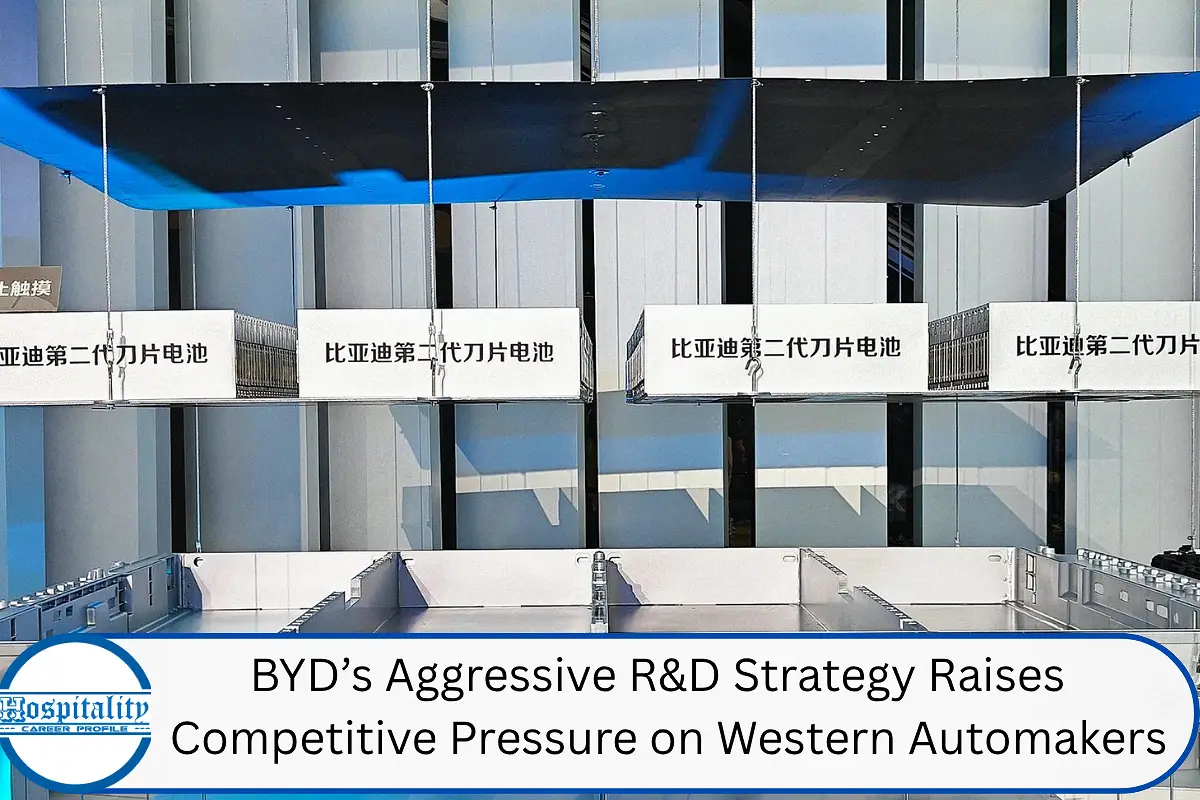
BYD’s Aggressive R&D Strategy Raises Competitive Pressure on Western Automakers
Chinese electric vehicle maker BYD is rapidly expanding its research and development capabilities, intensifying competitive pressure on Western automakers in 2026 as the global transition to electric mobility accelerates. The company’s heavy investment in innovation, advanced battery technology, and vertically integrated manufacturing is reshaping the competitive landscape of the automotive industry, particularly in Europe and North America.
BYD’s growing focus on R&D comes at a time when traditional automakers are racing to electrify their product lines while managing rising costs, regulatory demands, and supply chain challenges. The company’s ability to innovate quickly and scale production efficiently is increasingly seen as a major threat to established players.
Rapid Growth Driven by Innovation
BYD has significantly increased its spending on research and development over the past few years, focusing on core technologies such as batteries, electric drivetrains, and software systems. This strategy has enabled the company to introduce new models at a faster pace and improve performance, safety, and cost efficiency.
The company’s in-house development approach allows it to maintain control over key components, reducing reliance on external suppliers. This vertical integration not only enhances supply chain resilience but also accelerates the pace of innovation, giving BYD a competitive edge in a rapidly evolving market.
Industry analysts note that BYD’s ability to bring new technologies to market quickly is a key factor behind its strong sales growth and expanding global footprint.
Battery Technology as a Key Differentiator
Battery innovation remains central to BYD’s strategy. The company has focused on developing advanced battery technologies that offer improved safety, longer range, and lower costs. Its proprietary battery systems have gained recognition for their durability and efficiency, helping to position BYD as a leader in EV technology.
By producing batteries in-house, BYD is able to control costs more effectively and ensure consistent quality across its vehicle lineup. This capability has become increasingly important as battery costs remain a significant component of overall EV pricing.
The company’s advancements in battery design are also influencing broader industry trends, prompting competitors to accelerate their own research efforts.
Impact on Western Automakers
Western automakers are facing mounting pressure as BYD continues to expand its presence in global markets. Companies in Europe and the United States are investing heavily in electrification, but many are still in the early stages of transitioning from internal combustion engines to fully electric platforms.
BYD’s ability to offer competitively priced vehicles with advanced features is challenging the traditional pricing models of Western brands. This has raised concerns about profitability and market share, particularly in regions where cost sensitivity is high.
Automakers are responding by increasing their own R&D investments, forming strategic partnerships, and accelerating the development of new electric models. However, catching up with BYD’s pace of innovation remains a significant challenge.
Global Expansion Strategy
In addition to strengthening its technological capabilities, BYD is активно expanding into international markets. The company has been increasing its presence in Europe, Southeast Asia, and other regions, leveraging its competitive pricing and strong product offerings.
BYD’s global expansion is supported by growing demand for electric vehicles and government policies aimed at reducing carbon emissions. The company’s ability to adapt its products to different markets has been a key factor in its success abroad.
This international push is expected to further intensify competition, as BYD targets markets traditionally dominated by Western automakers.
Cost Efficiency and Scale
One of BYD’s major advantages lies in its cost efficiency. The company’s vertically integrated model allows it to reduce production costs and maintain competitive pricing without compromising on quality. This is particularly important in the EV market, where affordability remains a key factor for consumers.
BYD’s large-scale production capabilities also enable it to achieve economies of scale, further enhancing its competitiveness. As production volumes increase, the company can spread costs more effectively, improving margins and supporting continued investment in R&D.
These factors have contributed to BYD’s rapid growth and its ability to challenge established industry leaders.
Technological Ecosystem and Software Development
Beyond hardware, BYD is also investing in software development and digital technologies. The integration of advanced software systems into vehicles is becoming increasingly important, as consumers demand features such as connectivity, autonomous driving, and enhanced user experiences.
BYD’s focus on building a comprehensive technological ecosystem positions it to compete not only with traditional automakers but also with technology-driven companies entering the automotive space.
This approach reflects a broader shift in the industry, where software capabilities are becoming a key differentiator alongside hardware innovation.
Challenges and Risks
Despite its strengths, BYD faces several challenges as it expands globally. Regulatory requirements, trade barriers, and geopolitical tensions could impact its operations in certain markets. Additionally, maintaining quality and consistency across a growing product portfolio presents operational challenges.
Competition is also intensifying, with both established automakers and new entrants investing heavily in EV technology. This could lead to pricing pressures and increased competition for market share.
BYD will need to navigate these challenges while continuing to innovate and expand its global presence.
Industry Implications
The rise of BYD underscores a broader shift in the automotive industry, where Chinese manufacturers are emerging as major global players. The company’s success highlights the importance of innovation, cost efficiency, and scalability in the transition to electric mobility.
For Western automakers, the challenge is not only to catch up in terms of technology but also to adapt their business models to remain competitive in a rapidly changing market.
The increasing competition is expected to drive further innovation across the industry, benefiting consumers through improved products and more competitive pricing.
Conclusion
BYD’s aggressive investment in research and development is reshaping the global electric vehicle market, placing growing pressure on Western automakers to accelerate innovation and adapt to an increasingly competitive landscape.