Eli Lilly Partners with Nvidia to Deploy AI Supercomputer for Accelerating Drug Development
Eli Lilly has partnered with Nvidia to use AI supercomputing technology to accelerate drug discovery and development, marking a major step in pharma innovation.
 Akanksha jain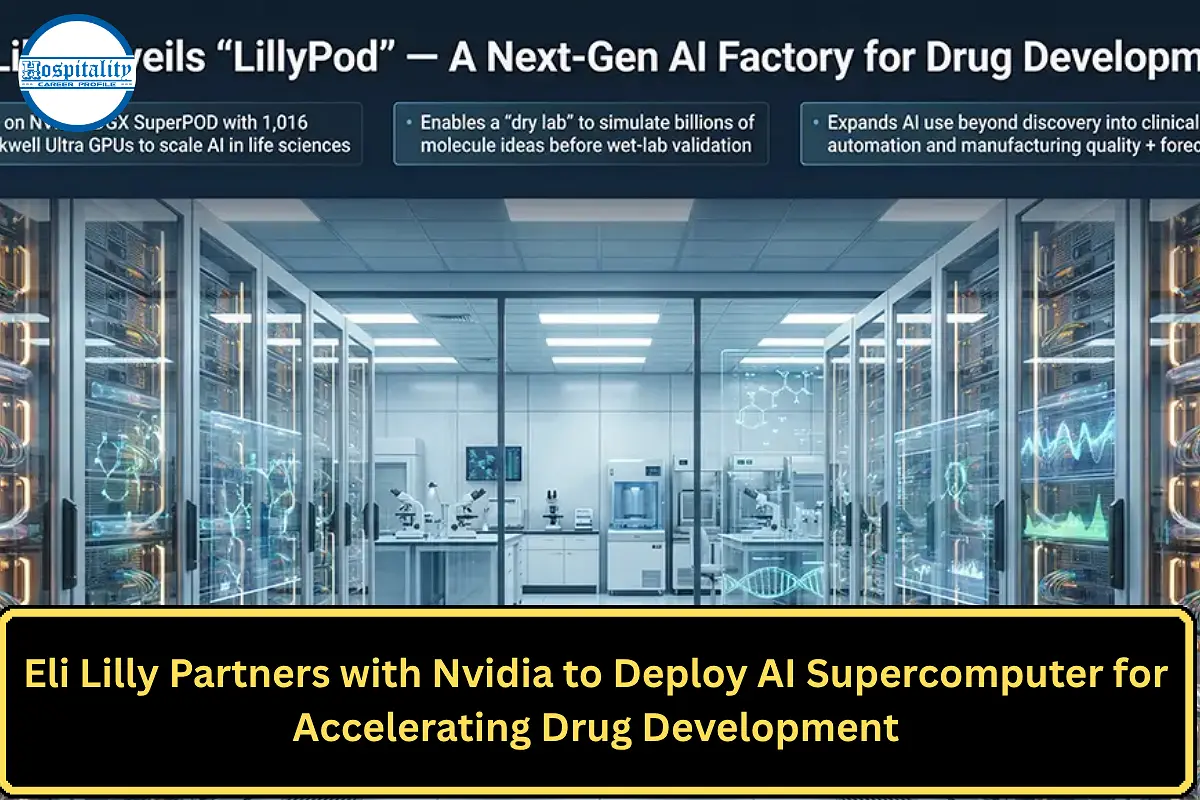
Eli Lilly Partners with Nvidia to Deploy AI Supercomputer for Accelerating Drug Development
Eli Lilly has partnered with Nvidia to deploy advanced artificial intelligence (AI) supercomputing capabilities aimed at accelerating drug discovery and development, the companies announced in 2026. The collaboration seeks to leverage cutting-edge computing power to improve the speed, efficiency, and success rates of developing new medicines, marking a significant step in the integration of AI within the pharmaceutical industry.
The partnership brings together Eli Lilly’s pharmaceutical expertise and Nvidia’s leadership in AI computing technology. By combining large-scale data processing with advanced machine learning models, the companies aim to streamline complex research processes, reduce development timelines, and enhance precision in identifying potential drug candidates.
Transforming Drug Discovery with AI
Drug discovery is traditionally a time-consuming and costly process, often taking years of research and billions of dollars in investment before a new medicine reaches the market. The use of AI and high-performance computing has emerged as a promising solution to address these challenges by enabling faster analysis of biological data and more accurate predictions of drug behavior.
Through this partnership, Eli Lilly plans to utilize Nvidia’s AI supercomputing infrastructure to analyze vast datasets, including genomic information, clinical trial data, and molecular structures. This capability is expected to significantly enhance the company’s ability to identify promising drug targets and optimize compounds at an earlier stage of development.
Researchers believe that AI-driven approaches can reduce the need for trial-and-error experimentation, allowing scientists to focus on the most viable candidates and improving overall efficiency in the development pipeline.
Role of Nvidia’s AI Supercomputing Technology
Nvidia’s AI supercomputing systems are designed to handle large-scale computations required for advanced machine learning applications. These systems can process massive datasets at high speed, enabling complex simulations and predictive modeling that are critical in pharmaceutical research.
The collaboration will involve the deployment of specialized hardware and software platforms capable of supporting deep learning models used in drug discovery. These models can simulate molecular interactions, predict the effectiveness of compounds, and identify potential safety concerns before clinical testing begins.
By integrating these capabilities into its research framework, Eli Lilly aims to accelerate the transition from early-stage discovery to clinical development, potentially bringing new treatments to patients more quickly.
Enhancing Research Efficiency and Precision
One of the key objectives of the partnership is to improve the precision of drug development. AI models can analyze patterns and relationships within complex datasets that may not be easily detectable through traditional methods. This can lead to more targeted therapies and better outcomes for patients.
The use of AI is also expected to reduce costs associated with drug development by minimizing the number of failed candidates and optimizing resource allocation. This could make the process more sustainable and enable companies to invest in a broader range of research initiatives.
Industry experts note that increased efficiency in drug development has the potential to address unmet medical needs more effectively, particularly in areas such as oncology, rare diseases, and chronic conditions.
Growing Role of AI in the Pharmaceutical Industry
The partnership between Eli Lilly and Nvidia reflects a broader trend in the pharmaceutical industry toward adopting digital technologies to enhance research and development. Companies are increasingly investing in AI, machine learning, and data analytics to improve decision-making and accelerate innovation.
AI-driven drug discovery has gained momentum in recent years, with several pharmaceutical and biotechnology companies forming collaborations with technology firms to harness computational power and expertise. These partnerships aim to bridge the gap between data science and life sciences, creating new opportunities for innovation.
Regulatory agencies are also beginning to recognize the potential of AI in drug development, although frameworks for its use are still evolving. Ensuring the reliability, transparency, and ethical use of AI remains a key consideration for industry stakeholders.
Implications for Patients and Healthcare
The adoption of AI in drug development has significant implications for patients, as it could lead to faster access to new treatments and improved therapeutic options. By reducing development timelines, companies can bring innovative medicines to market more quickly, addressing urgent healthcare needs.
Additionally, AI-driven approaches may enable the development of more personalized treatments, tailored to individual patient characteristics. This could improve treatment outcomes and reduce the risk of adverse effects.
Healthcare providers and patients alike stand to benefit from advancements that enhance the efficiency and effectiveness of the drug development process.
Challenges and Considerations
Despite its potential, the integration of AI into pharmaceutical research presents several challenges. These include the need for high-quality data, the complexity of developing accurate models, and the requirement for specialized expertise in both technology and life sciences.
Data privacy and security are also critical concerns, particularly when dealing with sensitive patient information. Companies must ensure that their systems comply with regulatory standards and protect data integrity.
Furthermore, the adoption of AI requires significant investment in infrastructure and training, which may pose challenges for smaller organizations.
Future Outlook
The collaboration between Eli Lilly and Nvidia is expected to play a key role in shaping the future of drug development. As AI technologies continue to evolve, their application in pharmaceutical research is likely to expand, leading to further improvements in efficiency and innovation.
Industry observers anticipate that similar partnerships will become more common as companies seek to remain competitive in a rapidly changing landscape. The integration of AI and high-performance computing is expected to redefine traditional approaches to drug discovery and development.
As the partnership progresses, its impact on research outcomes and timelines will be closely monitored by stakeholders across the healthcare and technology sectors.
Conclusion
Eli Lilly’s partnership with Nvidia to deploy AI supercomputing technology highlights the growing importance of digital innovation in pharmaceuticals, with the initiative aimed at accelerating drug development and improving patient outcomes worldwide.