Information Disorder Reshaping Global Politics, Study Warns
New research by political scientist Julia Morse highlights how misinformation and strategic messaging are reshaping international politics and global governance.
 SANJANA DUTTA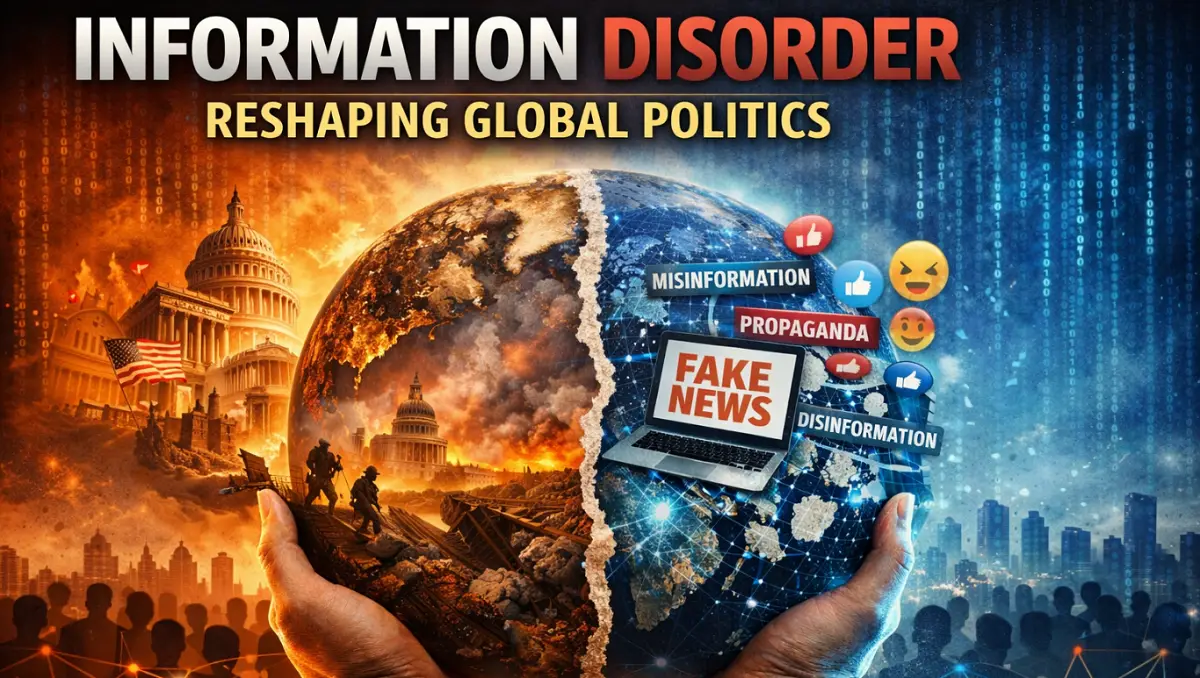
SANTA BARBARA, April 2026 — New research from the University of California, Santa Barbara finds that global political outcomes are increasingly shaped by perception, messaging, and information flow rather than objective facts, signalling a major shift in how power operates in international politics.
The findings, based on three academic studies led by political scientist Julia Morse, highlight how misinformation, strategic communication and declining trust in institutions are reshaping global governance, diplomacy and conflict response.
Strategic Messaging Shapes Accountability
In a study titled “Smoke and Mirrors: Strategic Messaging and the Politics of Noncompliance,” Morse and co-author Joseph Brown examine how governments respond to accusations of violating international law.
The research identifies key strategies, including outright denial, reinterpretation of legal norms and questioning the applicability of laws. Survey experiments involving U.S. respondents and international policy elites found that reinterpretation is particularly effective, as it is harder to disprove than direct denial.
The study also highlights the role of institutions such as the United Nations in countering misinformation. While credible information from such bodies can reduce the impact of false narratives, its effectiveness varies depending on how messages are framed.
Information Disorder Reshaping Global Politics
A second paper, “Information Disorder and Global Politics,” published in International Organization, argues that traditional assumptions about reliable information in international relations are breaking down.
The research finds that both the public and political elites are increasingly influenced by misleading or strategically framed narratives, complicating decision-making and weakening global cooperation.
This shift is contributing to growing challenges for democratic systems, as well as changing the dynamics of diplomacy and conflict.
Fragmentation Weakens Global Institutions
In a third study published in Ethics & International Affairs, Morse explores how fragmented information environments are affecting global governance.
The research finds that traditional institutions are facing rising gridlock and competing narratives, leading to the emergence of more flexible but less accountable informal governance structures.
While these informal systems can respond more quickly to crises, they raise concerns about transparency, legitimacy and long-term effectiveness.
Credibility Becomes Central to Power
Across all three studies, a central theme emerges: credibility is becoming a key source of power in international politics.
Morse’s earlier work, including her book The Banker’s Blacklist, showed how institutions influence behaviour through credible signals. Her latest research suggests that this influence is weakening as competing information sources make it harder to establish trust.
Even when accurate information is available, it often struggles to stand out in a crowded and fragmented media environment.
Implications for Global Policy
The findings point to a fundamental shift in global politics, where perception and communication are becoming as important as military or economic strength.
As information ecosystems evolve, the ability to shape narratives and maintain credibility is likely to remain a decisive factor in international decision-making.
The research suggests that understanding global events now requires analysing not only what states do, but how those actions are communicated — and perceived — across different audiences.