New Drying Technique Enables Vaccines to Remain Stable at Room Temperature
Researchers have developed a new drying technique that allows vaccines to remain stable at room temperature, potentially transforming global vaccine distribution.
 Akanksha jain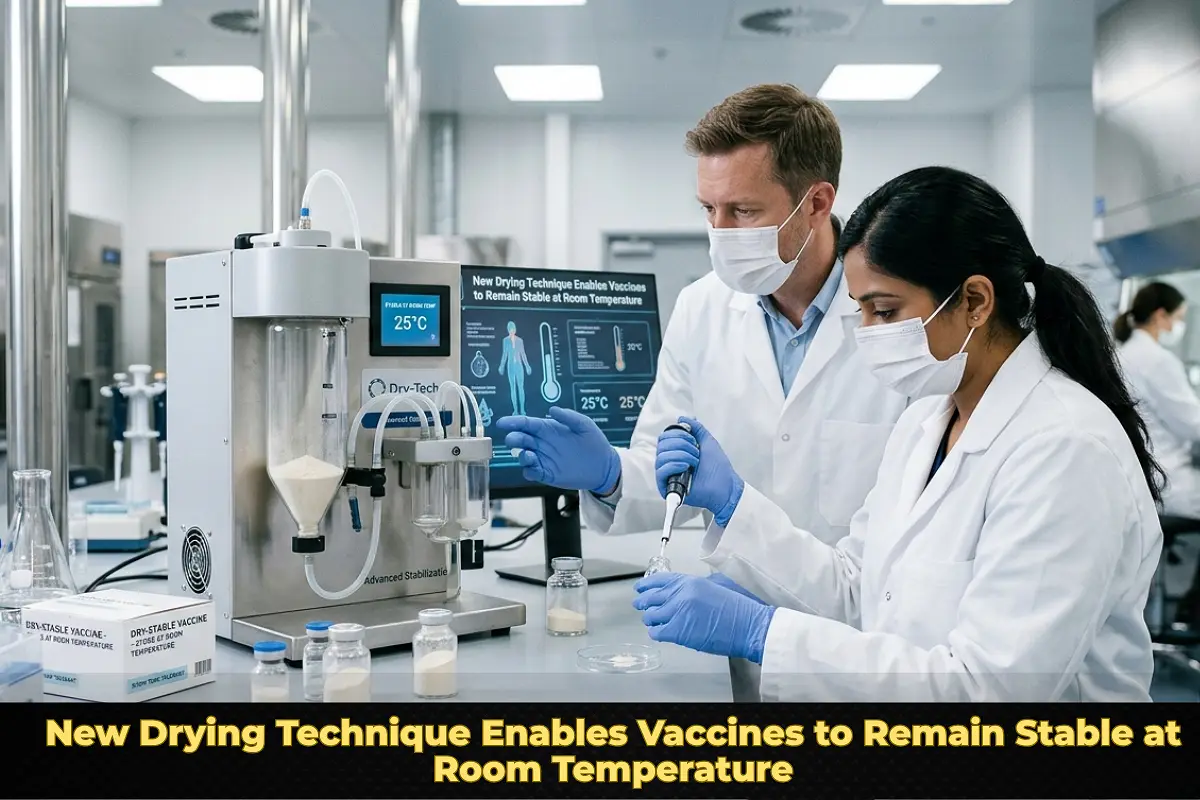
New Drying Technique Enables Vaccines to Remain Stable at Room Temperature
Researchers have developed a novel drying technique that allows vaccines to remain stable at room temperature, potentially eliminating the need for strict cold-chain storage, according to findings released in April 2026. The breakthrough, achieved by an international team of scientists, could significantly improve vaccine accessibility and distribution, particularly in low-resource and remote regions where refrigeration infrastructure is limited.
The innovation addresses one of the most persistent challenges in global immunization efforts: maintaining vaccines at controlled temperatures during storage and transportation. By stabilizing vaccines without refrigeration, the new method could reduce costs, minimize wastage, and expand access to life-saving immunizations worldwide.
Overcoming Cold-Chain Limitations
Most vaccines require storage at low temperatures to preserve their effectiveness, often between 2°C and 8°C, or even lower for certain formulations. This requirement creates logistical challenges, especially in regions lacking reliable electricity or refrigeration systems.
The new drying technique offers an alternative by preserving vaccine integrity at ambient temperatures. Researchers say the method can maintain stability for extended periods, reducing dependence on cold-chain logistics and simplifying distribution processes.
Experts note that overcoming cold-chain constraints could have a transformative impact on global vaccination campaigns, particularly in rural and underserved areas.
How the Drying Technique Works
The process involves removing moisture from vaccine formulations in a controlled manner while preserving their structural and functional properties. By carefully stabilizing the active components, the technique prevents degradation that would normally occur at higher temperatures.
The dried vaccines can later be reconstituted before administration, ensuring that their efficacy is retained. Researchers emphasize that the method is compatible with a range of vaccine types, including those based on proteins, viral vectors, and newer platforms.
This flexibility could allow the technology to be applied across multiple immunization programs.
Promising Laboratory Results
In laboratory testing, vaccines processed using the new technique demonstrated strong stability at room temperature over extended periods. The results suggest that the method can effectively preserve potency without compromising safety or performance.
Researchers observed that the dried formulations retained their ability to trigger immune responses comparable to traditionally stored vaccines. These findings indicate that the technique could meet the rigorous standards required for clinical use.
Further studies are planned to validate the results across different vaccine types and real-world conditions.
Implications for Global Health
The ability to store vaccines at room temperature could significantly enhance global immunization efforts by simplifying supply chains and reducing logistical barriers. This is particularly important in regions where maintaining refrigeration is difficult or costly.
Health organizations could distribute vaccines more efficiently, reaching populations that are currently underserved. The reduction in storage requirements may also decrease vaccine wastage caused by temperature fluctuations during transport.
Experts believe the innovation could play a crucial role in improving vaccination coverage and preventing disease outbreaks.
Cost and Efficiency Benefits
Eliminating the need for cold-chain infrastructure could lead to substantial cost savings for healthcare systems and governments. Refrigeration equipment, energy consumption, and specialized transport all contribute to the overall cost of vaccine distribution.
By enabling room-temperature storage, the new technique may reduce these expenses, making immunization programs more sustainable and scalable. The simplified logistics could also accelerate response times during public health emergencies.
Industry analysts highlight the potential economic benefits alongside the public health impact.
Applications Beyond Vaccines
While the current focus is on vaccines, the drying technique may also have applications in stabilizing other biological products, such as therapeutics and diagnostic reagents. Many of these products face similar challenges related to temperature sensitivity.
Expanding the technology to other areas could further enhance its impact across the healthcare sector. Researchers are exploring how the method can be adapted for different types of biological materials.
The broader applicability underscores the versatility of the approach.
Challenges and Next Steps
Despite its promise, the technique will need to undergo further testing and validation before it can be widely adopted. Clinical trials will be required to confirm safety and efficacy in real-world settings.
Regulatory approval processes will also play a critical role in determining how quickly the technology can be integrated into existing vaccine programs. Manufacturers may need to adapt production processes to incorporate the new method.
Researchers are working to optimize the technique and ensure it can be scaled for large-scale manufacturing.
Industry and Policy Impact
The development has attracted attention from policymakers and global health organizations seeking to improve vaccine accessibility. Innovations that simplify distribution are seen as key to addressing disparities in healthcare access.
Governments and international agencies may consider supporting the adoption of such technologies through funding, partnerships, and policy initiatives. Collaboration between research institutions and industry will be essential for translating the innovation into practical solutions.
The breakthrough aligns with broader efforts to strengthen global health systems and preparedness.
Future Outlook
As research progresses, the drying technique could become a standard approach for vaccine stabilization, particularly for use in challenging environments. Continued innovation in formulation and delivery methods is expected to enhance its effectiveness and applicability.
The potential to eliminate cold-chain requirements represents a major shift in how vaccines are stored and distributed, with implications for both routine immunization and emergency response.
Experts remain optimistic that the technology could play a key role in expanding access to vaccines and improving global health outcomes.
Conclusion
The development of a drying technique that stabilizes vaccines at room temperature marks a significant advancement in healthcare innovation, with further research and validation expected to determine its role in future immunization strategies.