North America Wildfires Burn Longer Nights Amid Climate Shift
Study finds wildfire-prone hours in North America up 36% in 50 years, with warmer nights fueling longer and more intense fires.
 Shah Vaibhavi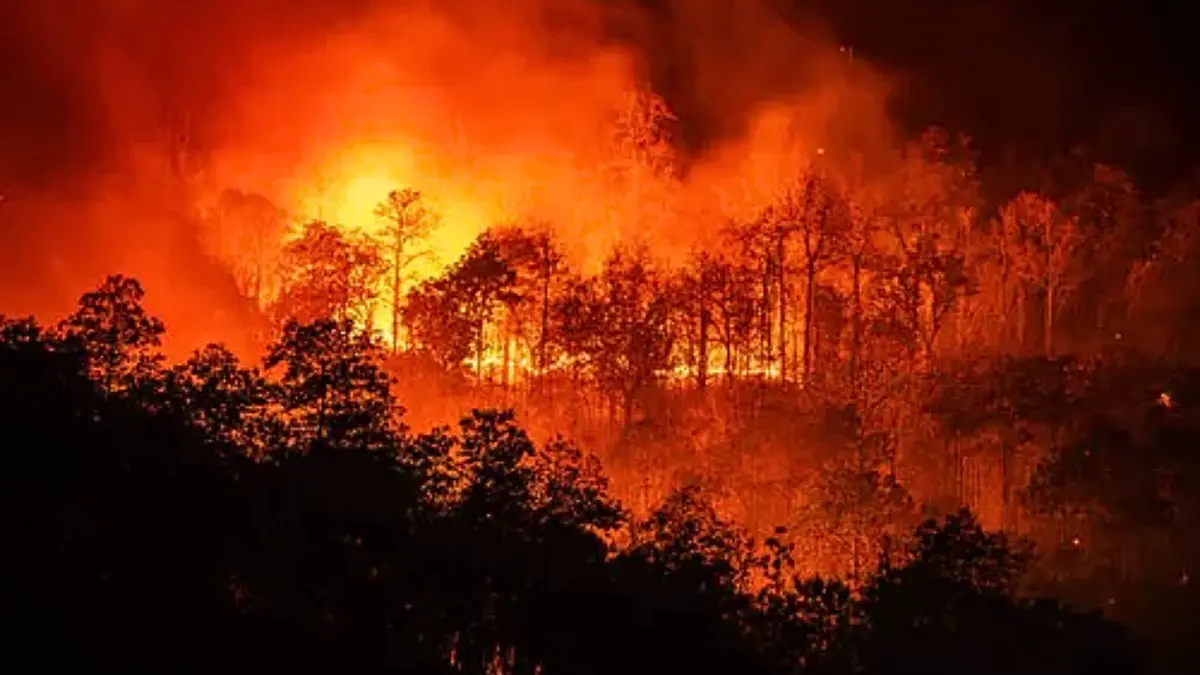
North America, April 18, 2026 — Wildfires across the United States and Canada are burning longer into the night and starting earlier in the day as climate change extends hot, dry conditions, with fire-prone weather hours rising 36 percent over the past 50 years, according to new research.
The study, published in Science Advances, shows that conditions favorable for wildfire spread have significantly expanded, altering long-standing fire behavior patterns. Historically, fires would weaken or stop overnight as temperatures dropped and humidity increased. Researchers now report that these nighttime slowdowns are becoming less frequent.
Fire-Prone Hours Increase Sharply Across Regions
Analysis indicates that North America now experiences substantially more hours each year when weather conditions support wildfire activity. Compared to the mid-1970s, California alone has gained approximately 550 additional annual hours of fire-conducive conditions.
The increase is even more pronounced in parts of the southwestern United States. Regions of southwestern New Mexico and central Arizona are experiencing up to 2,000 additional hours per year of weather suitable for wildfire spread. These figures reflect environmental conditions rather than continuous burning, but they highlight a significant expansion of risk windows.
The study also found that the number of days with fire-prone weather has risen by 44 percent over the same period, effectively adding 26 extra days annually. This extension affects both daily and seasonal fire activity.
Nighttime Burning Alters Fire Behavior
Wildfires have traditionally been less active at night due to cooler temperatures and increased moisture in the air. The new findings show that this pattern is changing, with fires increasingly continuing through nighttime hours.
Recent major fires, including those in Hawaii in 2023, Alberta in 2024 and Los Angeles in 2025, have demonstrated sustained nighttime activity. In one case, a major wildfire ignited shortly after midnight, highlighting how fire behavior is no longer confined to daytime conditions.
Researchers attribute this shift primarily to warmer and drier nights, combined with occasional increases in wind. Reduced overnight humidity means that fuels such as vegetation do not regain moisture, allowing fires to persist.
Warmer Nights and Drier Conditions Drive Change
Scientific data show that nighttime temperatures are rising faster than daytime temperatures due to heat-trapping gases from fossil fuel emissions. Since 1975, summer nighttime minimum temperatures in the contiguous United States have increased by 2.6 degrees Fahrenheit (1.4 degrees Celsius), compared to a 2.2 degree Fahrenheit (1.2 degree Celsius) rise in daytime highs.
This warming reduces the typical nighttime recovery period for ecosystems. Humidity levels no longer rebound as effectively after daytime drying, leaving vegetation and soil moisture levels depleted. These conditions create a continuous cycle of dryness that sustains fire activity.
Drought further intensifies the situation by producing hotter, drier air that extracts moisture from plants and soil. This process increases the flammability of vegetation, making it easier for fires to ignite and spread. Researchers describe this as a feedback loop in which dry conditions promote further drying.
Impacts on Firefighting and Risk Management
Extended burning hours present new challenges for wildfire management. Fires that remain active overnight carry momentum into the following day, increasing their intensity and making containment more difficult.
Nighttime firefighting operations are inherently more dangerous due to limited visibility and increased wildlife activity. These factors reduce the effectiveness of suppression efforts and heighten risks for personnel.
Researchers analyzed nearly 9,000 large fires between 2017 and 2023 using satellite-based weather data, including humidity, temperature, wind and fuel moisture. These observations were combined with a computer model to examine historical fire conditions across the United States and Canada from 1975 onward.
Rising Burn Area Reflects Long-Term Trends
The expansion of fire-prone conditions is reflected in the increasing area burned by wildfires. Between 2016 and 2025, wildfires in the United States burned an average of more than 11,000 square miles (28,500 square kilometers) annually, equivalent to the size of Massachusetts. This represents a 2.6-fold increase compared to the 1980s.
Canada has experienced a similar trend, with the average burned area over the past decade reaching 2.8 times the levels recorded in the 1980s. These increases underscore the growing scale and intensity of wildfire activity across the region.
The findings indicate that climate-driven changes in temperature, humidity and drought conditions are reshaping wildfire dynamics. The loss of nighttime relief periods and the expansion of fire-conducive weather windows are contributing to longer-lasting and more difficult-to-control fires across North America.