Scientists Map Physical Forces Driving Protein Movement, Opening New Pathways for Drug Discovery
Scientists have mapped the physical forces that drive protein movement, offering new insights that could transform drug discovery and molecular biology research.
 Akanksha jain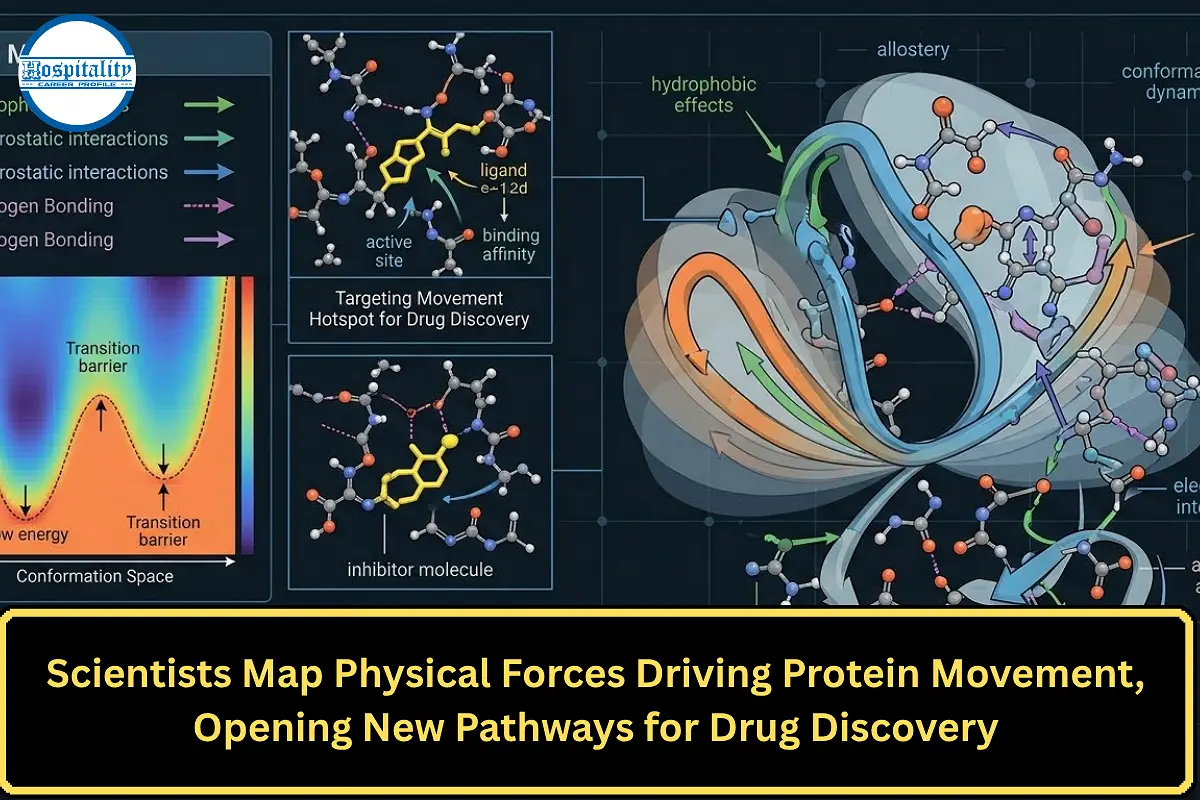
Scientists Map Physical Forces Driving Protein Movement, Opening New Pathways for Drug Discovery
Scientists have successfully mapped the physical forces that drive protein movement, according to new research published in March 2026, providing critical insights into how proteins function within the human body and opening new possibilities for drug discovery and disease treatment. The findings shed light on the fundamental mechanics of protein dynamics, a key factor in understanding biological processes at the molecular level.
The study, conducted by a team of interdisciplinary researchers, focuses on the forces that influence how proteins change shape, move, and interact with other molecules. These movements are essential for biological functions such as enzyme activity, cell signaling, and immune responses. By identifying the physical principles underlying these processes, scientists aim to improve the design of drugs that can precisely target specific proteins.
Understanding Protein Dynamics
Proteins are complex molecules that perform a wide range of functions in living organisms. Unlike static structures, proteins are highly dynamic, constantly shifting between different conformations to carry out their roles. These movements are influenced by a combination of physical forces, including thermal fluctuations, electrostatic interactions, and mechanical constraints.
The new research provides a detailed map of these forces, allowing scientists to better understand how proteins transition between different states. This understanding is crucial because even small changes in protein structure can significantly impact their function and, in some cases, lead to disease.
Researchers used advanced computational models and experimental techniques to observe protein behavior at an unprecedented level of detail. The integration of these approaches enabled them to capture both the structural and dynamic aspects of protein motion.
Implications for Drug Discovery
The ability to map protein motion has significant implications for drug discovery. Traditional drug development often focuses on targeting static protein structures, which may not fully represent how proteins behave in real biological environments. By incorporating knowledge of protein dynamics, scientists can design drugs that interact more effectively with their targets.
This approach could lead to the development of therapies that are more precise and have fewer side effects. For example, drugs could be designed to stabilize specific protein conformations associated with healthy function or to disrupt harmful interactions that contribute to disease.
The findings are particularly relevant for conditions such as cancer, neurodegenerative diseases, and infectious diseases, where protein behavior plays a critical role in disease progression.
Advanced Technologies Enable Breakthrough
The study was made possible by advancements in both computational and experimental technologies. High-performance computing allowed researchers to simulate protein movements over time, while cutting-edge imaging techniques provided real-world validation of these models.
Machine learning algorithms were also used to analyze large datasets and identify patterns in protein behavior. These tools helped researchers uncover relationships between physical forces and protein motion that were previously difficult to detect.
The combination of these technologies represents a significant step forward in molecular biology, enabling a more comprehensive understanding of complex biological systems.
Bridging Physics and Biology
One of the key aspects of the research is its interdisciplinary nature, bridging the fields of physics and biology. By applying principles of physics to biological systems, scientists can gain a deeper understanding of how molecular processes are governed by fundamental laws.
This approach has the potential to transform how researchers study biological systems, shifting the focus from descriptive models to predictive frameworks. Such frameworks can be used to anticipate how proteins will behave under different conditions, providing valuable insights for both basic research and applied science.
The integration of physics-based models into biological research is expected to drive innovation in multiple areas, including drug development, diagnostics, and synthetic biology.
Potential Impact on Disease Research
Understanding protein motion is essential for studying diseases that involve misfolded or malfunctioning proteins. Conditions such as Alzheimer’s disease, Parkinson’s disease, and certain types of cancer are associated with abnormal protein behavior.
By mapping the forces that drive these changes, researchers may be able to identify new therapeutic targets and develop strategies to correct or prevent harmful protein interactions. This could lead to more effective treatments and improved outcomes for patients.
The research also has implications for understanding how pathogens, such as viruses and bacteria, interact with host proteins. This knowledge could inform the development of antiviral and antibacterial therapies.
Challenges and Future Directions
Despite the promising findings, researchers acknowledge that there are still challenges to overcome. Protein systems are extremely complex, and capturing their full range of behavior requires significant computational resources and sophisticated experimental techniques.
Further research will be needed to refine the models and expand their applicability to a wider range of proteins and biological conditions. Collaboration between scientists from different disciplines will be critical in advancing this field.
Efforts are also underway to translate these findings into practical applications, including the development of new drug discovery platforms and diagnostic tools.
Global Research Significance
The study represents a major step forward in understanding the fundamental principles of life at the molecular level. It highlights the importance of basic research in driving innovation and underscores the potential for scientific discoveries to have far-reaching impacts on healthcare and medicine.
As researchers continue to explore the complexities of protein dynamics, the insights gained are expected to contribute to a new generation of medical technologies and therapies.
Institutions and research organizations worldwide are increasingly investing in this area, recognizing its potential to address some of the most pressing challenges in healthcare.
Conclusion
The mapping of physical forces that drive protein movement marks a significant advancement in molecular science, providing a foundation for future innovations in drug discovery and disease treatment while deepening understanding of fundamental biological processes.