Rijiju’s Remark on Priyanka Gandhi as LoP Triggers Political Exchange with Congress
Union Minister Kiren Rijiju’s remark suggesting Priyanka Gandhi would perform better as Leader of Opposition than Rahul Gandhi sparked a sharp response from Congress, intensifying political exchanges.
 SANJANA DUTTA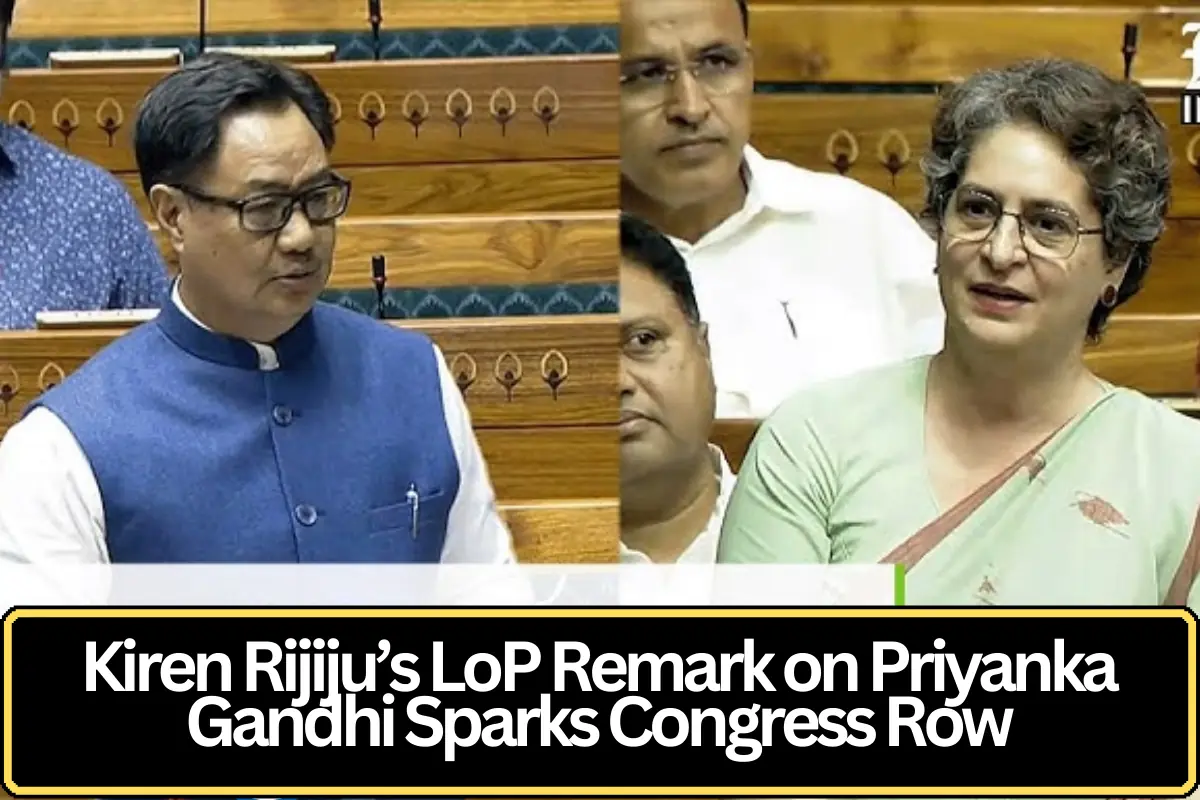
Introduction: Political Debate Over Leadership Comments
A recent political exchange between Union Minister Kiren Rijiju and Congress leader Priyanka Gandhi has sparked debate after Rijiju suggested that Priyanka Gandhi might perform better as Leader of the Opposition (LoP) than Rahul Gandhi. The comment quickly drew attention across political circles and triggered a response from the Congress leadership.
The episode highlights the ongoing political rivalry between the Bharatiya Janata Party (BJP) and the Congress party, where public remarks by senior leaders frequently become focal points of broader political discussions.
Rijiju’s Comment on Opposition Leadership
During a public interaction, Union Minister Kiren Rijiju made remarks suggesting that Priyanka Gandhi could potentially perform more effectively in the role of Leader of the Opposition compared to her brother Rahul Gandhi. His statement was widely interpreted as a political critique of Rahul Gandhi’s leadership within the opposition.
Political observers noted that such remarks often serve as strategic commentary within India’s competitive political environment, where leaders attempt to frame narratives around leadership strength and party performance.
The comment quickly circulated through media outlets and social media platforms, prompting reactions from opposition leaders.
Priyanka Gandhi Responds
Priyanka Gandhi responded to the remarks, dismissing the suggestion and defending her brother’s role in the opposition. She criticized the statement as an attempt to create unnecessary comparisons within the Congress leadership.
In her response, she emphasized that the party’s focus remains on addressing national issues and presenting an alternative political vision rather than engaging in personal comparisons or leadership speculation.
Her remarks reflected the Congress party’s effort to push back against criticism from political rivals while maintaining internal unity.
The Role of Leader of the Opposition
The Leader of the Opposition holds an important position in parliamentary democracies, serving as the primary representative of opposition parties in legislative debates and policy discussions. The role includes scrutinizing government policies, presenting alternative viewpoints, and ensuring accountability within parliamentary proceedings.
In India’s political system, the position also carries symbolic significance, representing the largest opposition party’s leadership in national political discourse.
Debates surrounding opposition leadership often emerge during periods of intense political competition, particularly as parties prepare for upcoming elections or parliamentary sessions.
BJP–Congress Political Rivalry
The exchange between Rijiju and Priyanka Gandhi reflects the broader rivalry between the BJP and Congress, India’s two most prominent national political parties. Political leaders from both sides frequently engage in public debates over leadership, policy decisions, and governance performance.
These exchanges often become part of the larger political narrative, influencing media coverage and public discussions about the direction of national politics.
Supporters of the BJP argue that criticism of opposition leadership is part of normal democratic debate, while Congress leaders often respond by accusing the ruling party of attempting to distract from policy issues.
Impact on Political Discourse
Political analysts note that leadership-focused remarks can influence public perceptions, particularly when they involve prominent figures within major political families. Comparisons between leaders may generate media attention but can also shift focus away from substantive policy discussions.
At the same time, such exchanges highlight the intense scrutiny faced by high-profile political leaders in India’s vibrant democratic environment.
Public reactions to the debate have been mixed, with supporters from both parties defending their respective leaders.
Looking Ahead
As political competition continues ahead of future electoral contests, exchanges between leaders from rival parties are likely to remain common. Both the BJP and Congress are expected to continue emphasizing their leadership narratives and political strategies in the months ahead.
Observers suggest that while leadership debates generate headlines, voters will ultimately focus on broader issues such as economic policy, governance performance, and development initiatives.
Conclusion
The remarks by Kiren Rijiju and the response from Priyanka Gandhi illustrate the dynamic and often contentious nature of Indian political discourse. While leadership comparisons may spark short-term debates, the broader political landscape will continue to be shaped by policy discussions, electoral strategies, and public engagement.