Solar Coronal Hole Triggers Northern Lights Across US States
A large coronal hole in the sun is driving high-speed solar winds, making northern lights visible across several U.S. states in April 2026.
 Shah Vaibhavi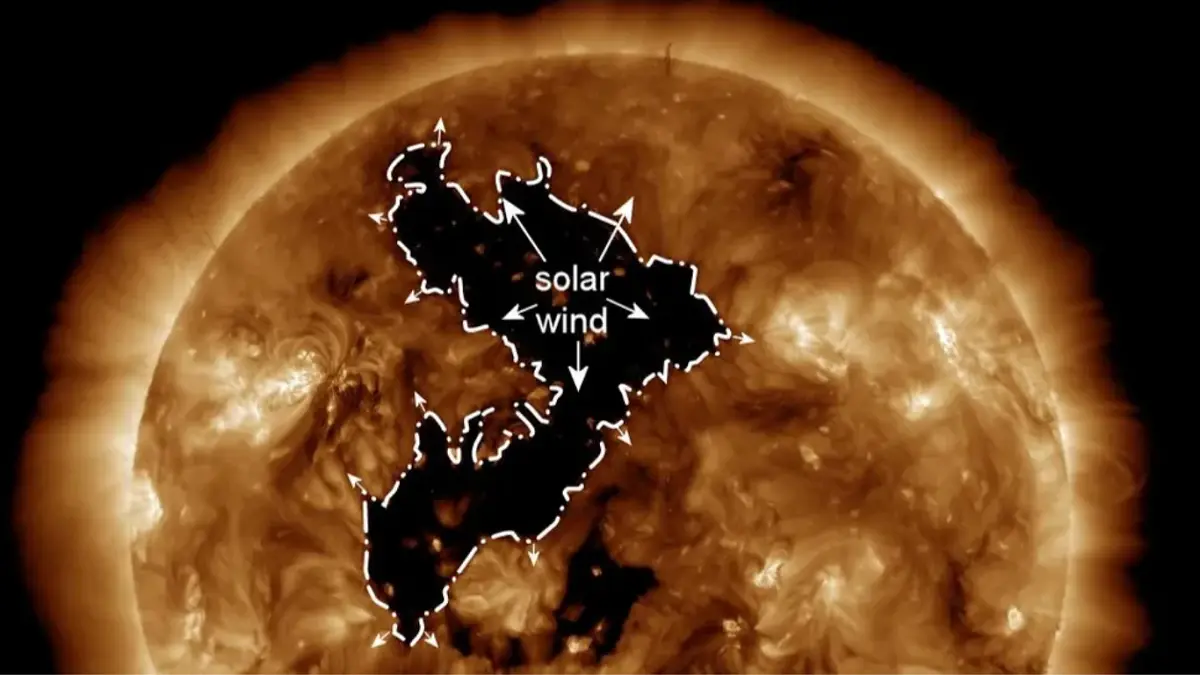
WASHINGTON, April 16, 2026 — A large coronal hole that opened in the sun’s atmosphere this week is sending high-speed solar winds toward Earth, creating conditions that could make the northern lights visible across several U.S. states on April 17 and 18.
The event is expected to expand aurora visibility farther south than usual, with forecasts indicating potential sightings as far as Idaho and New York. The phenomenon is driven by intensified solar wind streams interacting with Earth’s magnetic field, producing visible auroras in regions that do not typically experience them.
Coronal hole drives high-speed solar winds
The solar activity originates from a coronal hole — a region in the sun’s atmosphere where magnetic field lines open outward, allowing charged particles to escape at high speeds. These streams of solar wind travel through space and, upon reaching Earth, disturb the planet’s magnetosphere.
This disturbance enables charged particles to collide with gases in Earth’s upper atmosphere, releasing energy in the form of light. These interactions create the aurora borealis, commonly known as the northern lights.
Aurora visibility extends across multiple states
According to forecasts, the auroral display may be visible across several northern U.S. states during the nights of April 17 and early April 18. The viewing window is expected to be strongest during late-night and pre-dawn hours when skies are darkest and solar activity aligns with Earth’s magnetic field.
The geographic range of visibility includes areas farther south than typical aurora zones, highlighting the intensity of the current solar wind conditions. Such expansions occur when solar wind speeds and density increase significantly, enhancing geomagnetic activity.
Mechanism behind aurora formation
The northern lights form when magnetic field lines on the sun’s surface become tangled and eventually snap, releasing bursts of charged particles into space. These particles, known as solar wind, carry energy that interacts with Earth’s magnetic field upon arrival.
As the particles enter Earth’s atmosphere, they collide with oxygen and nitrogen molecules, producing glowing emissions. The colors and intensity of the aurora depend on the type of gas involved and the altitude at which the collisions occur.
Favorable conditions for observation
The predicted auroral display benefits from strong solar wind conditions generated by the coronal hole. Clear skies and minimal light pollution will be critical for optimal viewing, particularly in regions near the southern edge of the visibility zone.
The timing of the event aligns with nighttime hours, improving the chances of observing the phenomenon. However, visibility will depend on local weather conditions and the strength of geomagnetic activity at the time.
Context within ongoing solar activity
Coronal holes are a recurring feature of the sun’s activity cycle, periodically releasing streams of solar wind that can influence space weather near Earth. These events can lead to enhanced auroral displays when conditions align with Earth’s magnetic environment.
The current occurrence highlights how variations in solar activity can temporarily extend aurora visibility beyond typical high-latitude regions. Such events provide opportunities for observation in areas where the northern lights are rarely seen.
The predicted displays for mid-April reflect ongoing interactions between solar emissions and Earth’s atmosphere, demonstrating the direct impact of solar dynamics on observable environmental phenomena.