Steve Wozniak Questions AI Capabilities, Says Technology Cannot Replace Human Thinking
Apple co-founder Steve Wozniak expresses skepticism about artificial intelligence, stating it cannot fully replace human thinking and creativity.
 RUKAIYA KADIVAL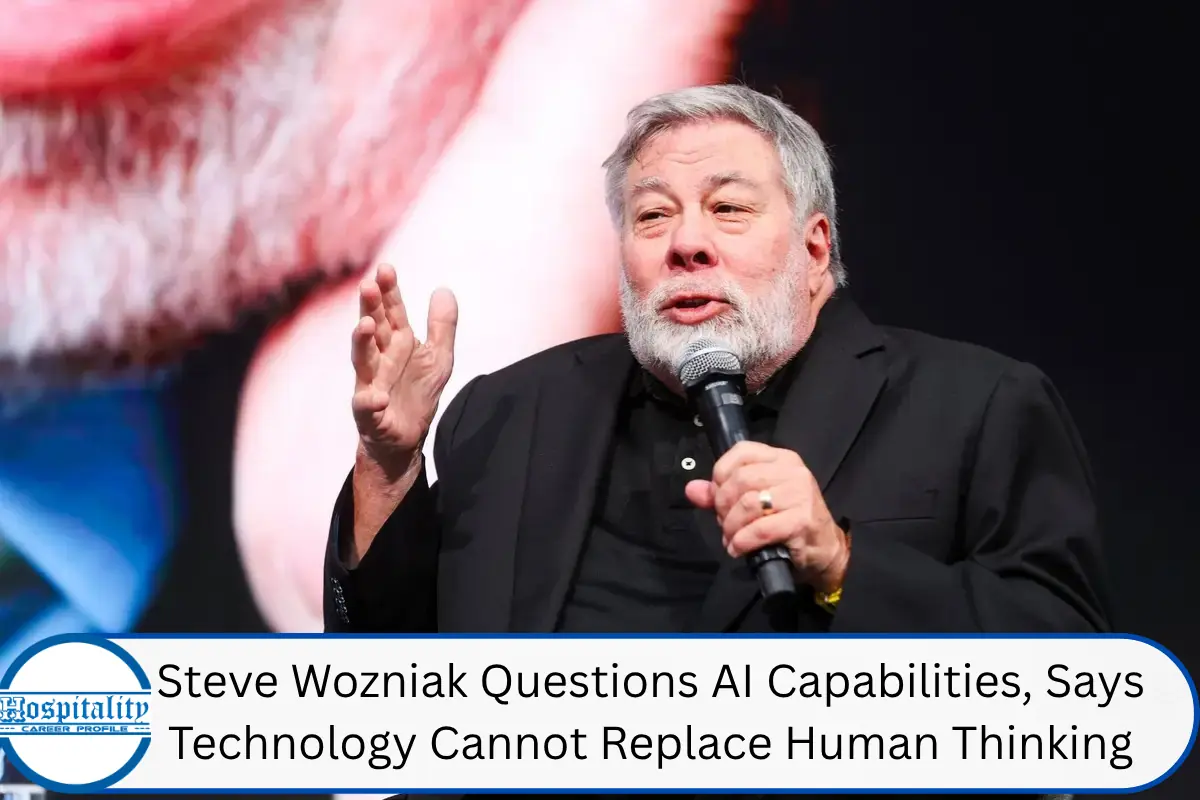
Steve Wozniak Questions AI Capabilities, Says Technology Cannot Replace Human Thinking
Apple co-founder Steve Wozniak has expressed skepticism about the growing capabilities of artificial intelligence, stating that AI may not be able to fully replace human thinking and creativity, according to remarks reported on March 27. Speaking amid rapid advancements in AI technologies, Wozniak emphasized that true human-like intelligence requires lived experience, something machines inherently lack.
His comments come at a time when artificial intelligence is being increasingly integrated into industries ranging from finance and healthcare to consumer technology, with many experts debating whether machines could eventually rival or surpass human intelligence.
Wozniak, a prominent figure in the technology industry, highlighted that while AI systems can process large amounts of data and perform complex tasks, they do not possess genuine understanding or consciousness. He argued that human intelligence is shaped by emotions, experiences, and personal interactions—elements that cannot be replicated by algorithms.
AI Advancements Spark Debate
The rapid evolution of artificial intelligence has sparked widespread discussions about its potential impact on jobs, creativity, and decision-making. Generative AI tools, in particular, have demonstrated the ability to produce text, images, and even software code, leading to speculation about the future role of humans in various professions.
Despite these advancements, Wozniak believes that AI remains fundamentally limited. He noted that machines rely on pre-existing data and patterns, whereas humans can think independently, adapt to new situations, and create original ideas without relying solely on past inputs.
Industry experts remain divided on the issue, with some predicting that AI will continue to augment human capabilities rather than replace them entirely.
Human Experience as a Key Differentiator
According to Wozniak, one of the key factors distinguishing humans from machines is the ability to “live” and experience the world. He suggested that true intelligence involves more than computation—it requires awareness, emotions, and the ability to interpret complex social and ethical contexts.
AI systems, by contrast, operate within defined parameters and lack the subjective experiences that shape human decision-making. This limitation, he argued, prevents AI from achieving a level of understanding comparable to that of humans.
His perspective aligns with a broader view among some technologists who believe that while AI can simulate certain aspects of intelligence, it cannot replicate the full depth of human cognition.
Growing Role of AI in Industry
Artificial intelligence continues to play an increasingly important role across industries, driving efficiency, automation, and innovation. Companies are investing heavily in AI technologies to enhance productivity, improve customer experiences, and gain competitive advantages.
In sectors such as healthcare, AI is being used for diagnostics and treatment planning, while in finance, it supports risk analysis and fraud detection. Consumer technology companies are also integrating AI into devices and services, making it a central component of modern digital ecosystems.
Despite these developments, Wozniak’s comments serve as a reminder that technological progress does not necessarily equate to human equivalence.
Balancing Optimism and Caution
The debate over AI’s potential has led to a mix of optimism and caution among industry leaders. While many see AI as a transformative force capable of solving complex problems, others emphasize the need to understand its limitations and ethical implications.
Wozniak’s remarks reflect a cautious approach, urging stakeholders to recognize the distinction between machine capabilities and human intelligence. He suggested that overestimating AI could lead to unrealistic expectations and potential risks.
Policymakers and organizations are increasingly focusing on responsible AI development, ensuring that technologies are used ethically and transparently.
Impact on Workforce and Creativity
One of the key concerns surrounding AI is its impact on employment and creative industries. Automation has already transformed certain job roles, raising questions about the future of work in an AI-driven world.
Wozniak indicated that while AI can assist with tasks and improve efficiency, it is unlikely to replace the uniquely human aspects of creativity and innovation. He emphasized that human input will remain essential in areas requiring critical thinking, empathy, and originality.
Experts suggest that the future workforce will likely involve collaboration between humans and AI, rather than direct competition.
Future Outlook for Artificial Intelligence
Looking ahead, artificial intelligence is expected to continue evolving, with advancements in machine learning, natural language processing, and robotics. These developments could expand the range of tasks that AI can perform, further integrating it into everyday life.
However, the question of whether AI can achieve true human-like intelligence remains unresolved. Wozniak’s perspective highlights the ongoing debate and underscores the importance of maintaining realistic expectations about the technology.
As AI continues to shape the future, balancing innovation with an understanding of its limitations will be critical for sustainable development.
Conclusion
Steve Wozniak’s comments add to the growing discourse on artificial intelligence, emphasizing that while AI is a powerful tool, it is unlikely to fully replace human thinking, with its future role expected to complement rather than substitute human intelligence.