Four-Way Battle Shapes Tamil Nadu 2026 Elections
Tamil Nadu’s 2026 Assembly elections are shaping into a four-way contest with DMK, AIADMK-BJP, TVK and NTK competing amid shifting alliances and voter dynamics.
 SANJANA DUTTA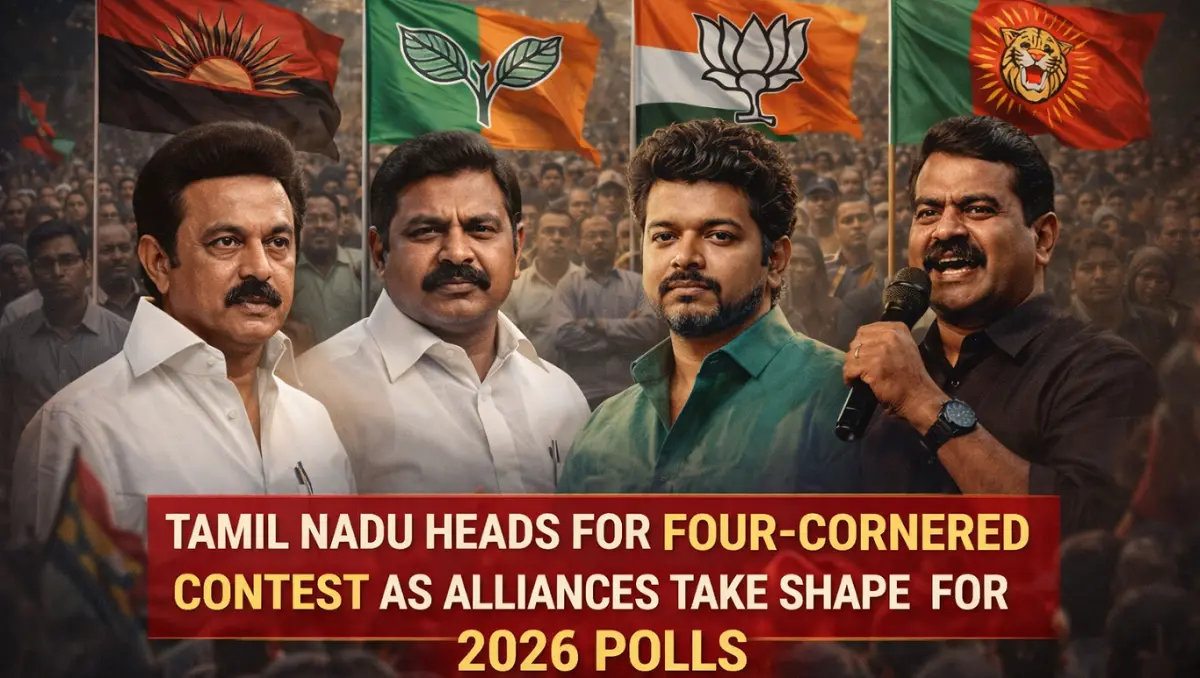
CHENNAI, April 9, 2026 — Tamil Nadu’s political landscape is heading toward a rare four-cornered contest ahead of the 2026 Assembly elections, with the ruling DMK-led Secular Progressive Alliance seeking re-election amid challenges from an AIADMK-BJP alliance, actor Vijay’s Tamilaga Vettri Kazhagam, and Seeman’s Naam Tamilar Katchi.
Four-Way Contest Reshapes Electoral Dynamics
The upcoming election marks a significant departure from the traditionally bipolar contests in Tamil Nadu politics. The ruling Dravida Munnetra Kazhagam (DMK), which heads the Secular Progressive Alliance, is preparing to defend its tenure while facing a consolidated opposition front formed by the All India Anna Dravida Munnetra Kazhagam (AIADMK) and the Bharatiya Janata Party (BJP).
Adding to the complexity is the entry of actor-turned-politician Vijay, whose party, Tamilaga Vettri Kazhagam (TVK), has announced plans to contest widely on its own. Meanwhile, Seeman-led Naam Tamilar Katchi (NTK) continues to position itself as an independent alternative, further fragmenting the electoral field.
This evolving scenario signals a shift in voter alignment and introduces multiple competitive poles, making the 2026 election one of the most closely watched in recent years.
DMK Strategy and Leadership Position
Within this emerging framework, the DMK leadership has indicated its intent to approach the election with a focus on governance and continuity. Kanimozhi Karunanidhi, Member of Parliament and Parliamentary Party Leader of the DMK, outlined the party’s perspective in an interaction with media, highlighting how the party views the intensifying contest.
The DMK-led alliance is seeking another term in office, positioning its campaign around its record in governance and welfare delivery. The leadership has also indicated that electoral competition will be shaped by broader questions concerning administrative performance and policy direction.
Kanimozhi’s remarks reflect the party’s attempt to frame the election not merely as a contest for power but as a referendum on governance and political priorities in the state.
Opposition Consolidation and New Entrants
The alliance between the AIADMK and the BJP represents a key development in the opposition’s strategy to counter the DMK-led coalition. By joining forces, the two parties aim to consolidate anti-incumbency votes and present a unified challenge.
At the same time, Vijay’s TVK has emerged as a new political force. The party’s decision to contest independently suggests an effort to build a distinct support base rather than align with existing coalitions. This move is expected to draw attention from sections of voters seeking alternatives beyond traditional party structures.
Parallelly, NTK continues to maintain its independent stance under Seeman’s leadership, emphasizing its role as an alternative voice in the state’s political discourse.
The presence of multiple contenders introduces uncertainties in vote distribution and could influence outcomes across constituencies.
Key Issues: Governance, Welfare and Federal Rights
The 2026 Assembly elections are expected to revolve around several key issues, including governance, welfare schemes, and the assertion of federal rights. Political discourse in the state has increasingly focused on the balance between state autonomy and central influence, a recurring theme in Tamil Nadu politics.
Welfare policies are also likely to play a central role, with parties expected to highlight their track records and proposals aimed at addressing economic and social concerns.
Debates around governance performance, delivery of public services, and administrative accountability are anticipated to shape voter preferences as the campaign progresses.
Impact on Dravidian Political Trajectory
The outcome of the 2026 elections is expected to carry broader implications for the trajectory of Dravidian politics in Tamil Nadu. Historically dominated by the DMK and AIADMK, the political landscape is now witnessing new entrants and shifting alliances that could redefine traditional equations.
The emergence of a four-cornered contest underscores a potential transformation in electoral competition, with multiple parties seeking to expand their influence and redefine voter bases.
As campaigning intensifies, the election is likely to test not only party strategies but also the resilience of established political frameworks in the state.
With alliances evolving and voter dynamics in flux, the Tamil Nadu Assembly elections are set to become a pivotal contest, reflecting broader changes in regional and national political trends.