Congress Alleges Government Convened Special Session for Political Mileage
The Congress party has accused the government of calling a special parliamentary session to gain political mileage, intensifying political tensions in India.
 SANJANA DUTTA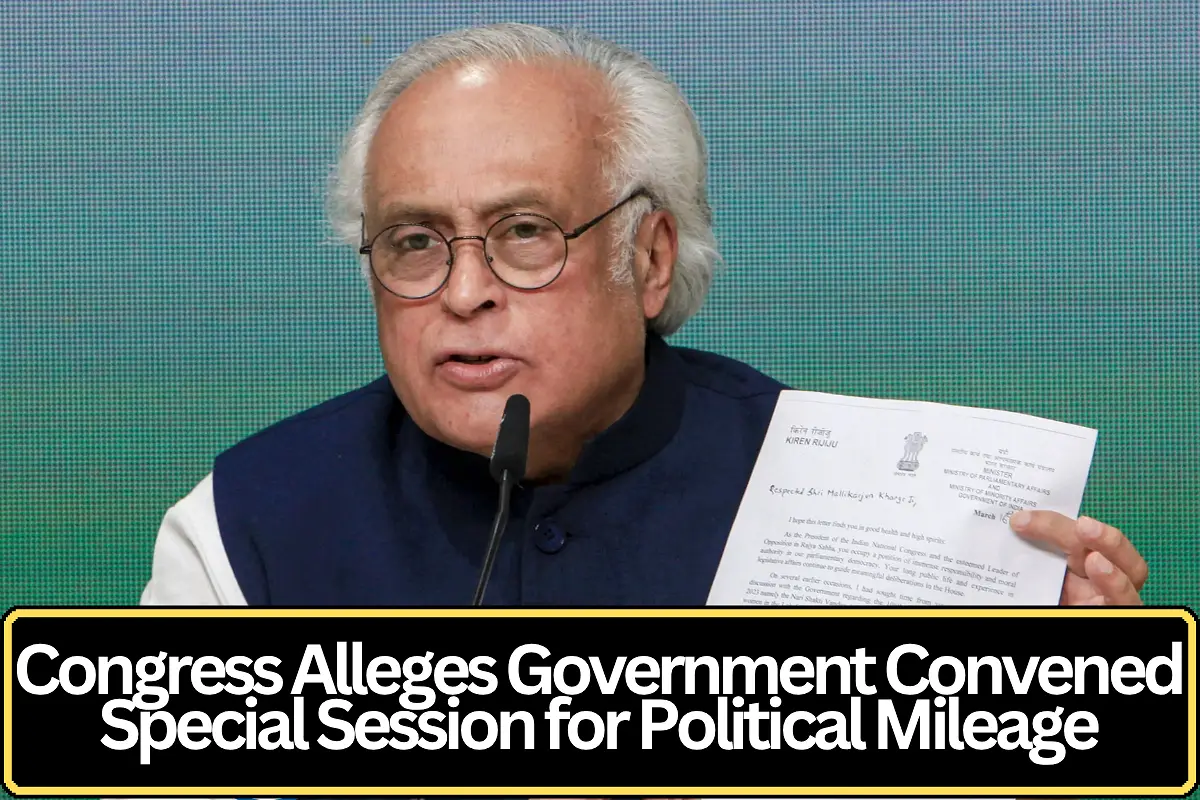
Congress Alleges Government Convened Special Session for Political Mileage
NEW DELHI, April 4, 2026 — The Congress party has accused the central government of convening a special session of Parliament primarily to secure political mileage, escalating tensions between the ruling administration and the opposition amid an increasingly charged political climate.
The allegation comes as political parties prepare for key debates expected during the session, with the opposition questioning both the timing and intent behind the move. Congress leaders argued that the session lacks substantive legislative urgency and is instead aimed at shaping public perception ahead of upcoming political developments.
Opposition Questions Intent Behind Special Session
Senior Congress leaders stated that the decision to call a special session appears to be politically motivated rather than driven by pressing governance needs. They contended that the government is attempting to use parliamentary proceedings as a platform to highlight its achievements and counter criticism from opposition parties.
The party further alleged that such sessions should be reserved for critical national issues requiring immediate legislative attention, rather than being used as a political tool. According to opposition representatives, the move risks undermining the seriousness and institutional integrity of parliamentary processes.
Congress spokespersons emphasized that Parliament must function as a forum for meaningful debate and policy-making, not as a stage for political messaging. They warned that repeated use of special sessions for non-essential matters could set an undesirable precedent.
Government Defends Decision
In response, government officials defended the decision to convene the session, stating that it provides an opportunity to address important national issues and engage in constructive dialogue. They rejected the opposition’s allegations, asserting that parliamentary sessions are essential for transparency and democratic functioning.
Officials indicated that the session’s agenda includes discussions on economic priorities, governance reforms, and other policy matters. They argued that the opposition’s criticism reflects political differences rather than any procedural impropriety.
The government also maintained that calling special sessions is within its constitutional prerogative and has precedent in India’s parliamentary history. It highlighted that such sessions can serve as an important mechanism to deliberate on emerging challenges.
Political Context and Rising Tensions
The controversy unfolds against a backdrop of heightened political activity across the country, with multiple states witnessing electoral preparations and policy debates gaining intensity. Political parties are increasingly focused on shaping narratives that resonate with voters.
Analysts suggest that both the ruling party and the opposition are leveraging every available platform to strengthen their positions. In this context, parliamentary sessions, particularly special ones, assume greater significance as they attract public and media attention.
The Congress party’s remarks are part of a broader strategy to challenge the government’s decisions and highlight concerns about governance priorities. Meanwhile, the ruling party continues to emphasize its policy initiatives and legislative agenda.
Debate Over Parliamentary Norms
The dispute has also reignited discussions on the role and purpose of special sessions within India’s parliamentary framework. Traditionally, such sessions have been convened to address urgent national matters, commemorate significant events, or pass critical legislation.
Critics argue that frequent or strategically timed special sessions could dilute their significance, while supporters contend that they provide flexibility in addressing evolving governance needs. The current debate reflects differing interpretations of parliamentary norms and political strategy.
Experts note that maintaining a balance between political objectives and institutional integrity is crucial for sustaining public trust in democratic processes. The use of parliamentary mechanisms for political advantage remains a contentious issue.
Public and Political Reactions
Reactions to the controversy have been mixed, with some observers supporting the opposition’s concerns while others backing the government’s right to convene sessions as needed. Public discourse has been shaped by broader political affiliations and perspectives.
Several regional parties have also weighed in, with some aligning with the Congress party’s criticism and others adopting a more neutral stance. The issue has added to the ongoing political discourse surrounding governance and accountability.
Political analysts suggest that such debates are likely to intensify as the session progresses, particularly if contentious issues dominate the agenda. The tone and substance of parliamentary discussions will be closely monitored.
Implications for Legislative Functioning
The controversy may have implications for the functioning of Parliament, particularly if disagreements between the government and opposition affect proceedings. Disruptions, protests, or walkouts could impact the legislative output of the session.
At the same time, the session presents an opportunity for dialogue and engagement on key national issues. Whether it leads to constructive outcomes or further political polarization will depend on the conduct of both sides.
Observers note that effective parliamentary functioning requires cooperation and mutual respect among political actors, even amid differences. The current situation underscores the challenges of achieving this balance in a competitive political environment.
Historical Precedents
India has witnessed several special parliamentary sessions in the past, often convened for significant legislative or commemorative purposes. These have included landmark policy decisions and symbolic events marking important milestones.
However, the interpretation of such sessions as political tools is not new, with opposition parties historically questioning the motives behind their timing and agenda. The present controversy reflects a continuation of this pattern.
Analysts suggest that the evolving political landscape has increased the strategic use of institutional mechanisms, making debates over intent and purpose more pronounced.
Future Outlook
As the special session approaches, attention will focus on its agenda, proceedings, and outcomes. Both the government and opposition are expected to use the platform to advance their narratives and engage in political positioning.
The extent to which the session addresses substantive issues or becomes a forum for political contestation will shape its overall impact. Observers will also assess its implications for future parliamentary practices.
The developments are likely to influence broader political dynamics, particularly as parties prepare for upcoming electoral challenges and policy debates.
Conclusion
The Congress party’s allegation that the special session is aimed at gaining political mileage highlights ongoing tensions in India’s political landscape and raises questions about the use of parliamentary mechanisms.
Current Status
The situation remains fluid, with both the government and opposition preparing for the session as political exchanges continue to intensify.