Cygnus X-1 Jets Emit Energy Equal to 10,000 Suns
A new study finds Cygnus X-1 emits jets with energy equal to 10,000 suns, offering the first direct measurement of black hole jet power.
 Shah Vaibhavi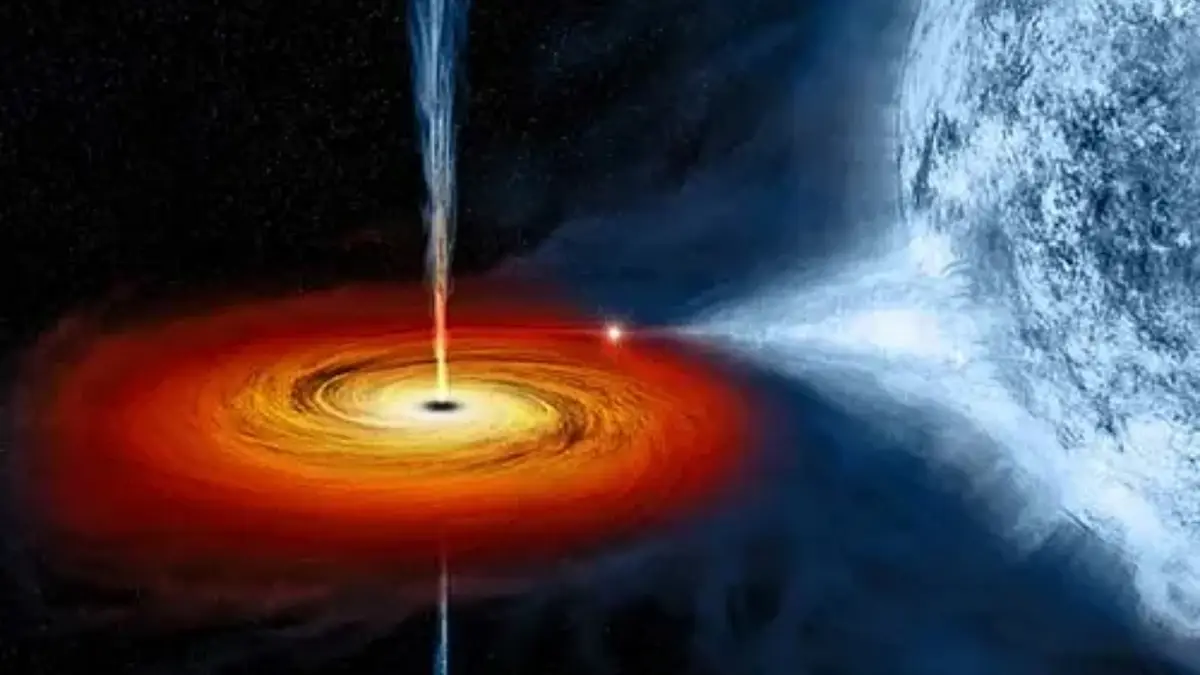
April 17, 2026 — An international research team has measured the energy output of jets from Cygnus X-1, the first confirmed black hole, revealing that the system emits energy equivalent to 10,000 suns. The findings provide one of the most precise observational estimates of black hole jet power to date.
The study, led by Curtin University and published in Nature Astronomy, analyzed high-resolution observations from a global network of telescopes. By tracking how the jets interact with surrounding stellar winds, researchers were able to calculate their speed and energy with unprecedented accuracy.
Jets travel at half the speed of light
The analysis shows that the jets emitted by Cygnus X-1 travel at approximately 150,000 kilometers per second, or about half the speed of light. These high-speed outflows are composed of particles accelerated to extreme energies as matter falls toward the black hole.
As particles approach relativistic speeds, they release intense radiation, producing the bright emissions associated with black hole jets. The observed behavior aligns with predictions from relativistic physics, where energy increases significantly as velocity approaches the speed of light.
The researchers observed that the jets are not static streams but are influenced by external forces. Stellar winds from the companion star push and bend the jets, allowing scientists to measure how much energy they carry based on their motion and deformation.
Energy output reaches 10,000 solar equivalents
Using these observations, the team determined that the jets produce energy comparable to the brightness of 10,000 suns. This quantification provides a rare direct measurement of jet power, which has previously been difficult to confirm through observation.
According to the study, around 10 percent of the energy generated as matter is pulled into the black hole is redirected into these jets. This proportion has long been assumed in theoretical models of galaxy formation and black hole behavior, but direct evidence has been limited.
The new measurement supports these models, offering observational validation of how efficiently black holes convert infalling matter into high-energy outflows.
Global telescope network enabled measurement
The research relied on a coordinated network of telescopes distributed around the world. By combining data from multiple instruments, scientists captured detailed images of the jets over time, allowing them to track changes caused by the black hole’s orbital motion.
Cygnus X-1 exists in a binary system, orbiting a companion star every 5.6 days. As the black hole moves, the stellar winds from its companion interact with the jets, creating distortions similar to how wind affects a stream of water. These distortions were critical for estimating the jets’ القوة and direction.
This method provided a new approach to measuring jet energy, overcoming previous limitations where direct observations could not fully capture the dynamics of these high-speed outflows.
Cygnus X-1: a benchmark in black hole research
Located about 7,000 light-years from Earth, Cygnus X-1 is a stellar-mass black hole approximately 21 times more massive than the Sun. It is paired with a massive companion star, HDE 226868, which is nearly twice the size of the Sun.
First identified in 1964 and confirmed as a black hole in 1971, Cygnus X-1 has been one of the most extensively studied objects in astrophysics. Its relatively close distance and strong emissions make it an ideal system for examining black hole behavior.
Prior to this study, Cygnus X-1 was considered among the most massive and rapidly spinning stellar-mass black holes known. The new findings add another dimension to its profile by providing concrete measurements of its jet energy output.
Findings support long-standing theoretical models
The study’s results reinforce existing theoretical frameworks that describe how black holes release energy. Models of galaxy evolution often assume that jets carry away a fraction of the energy generated by accretion, influencing surrounding environments.
By confirming that roughly 10 percent of accreted energy is transferred into jets, the research provides empirical support for these assumptions. This has implications for understanding how black holes impact their host galaxies through energy feedback.
The ability to directly measure jet power also opens the possibility of applying similar techniques to other black hole systems. This could help refine models of cosmic structure formation and the role of high-energy astrophysical processes.
The study demonstrates how coordinated global observations can reveal previously inaccessible details about extreme cosmic phenomena, offering new insights into the mechanics of black holes and their influence on the universe.