DESI Completes Largest 3D Universe Map, Tracks 11 Billion Years
DESI completes the largest 3D map of the universe, tracing 11 billion years of cosmic history to study dark energy and galaxy distribution.
 Shah Vaibhavi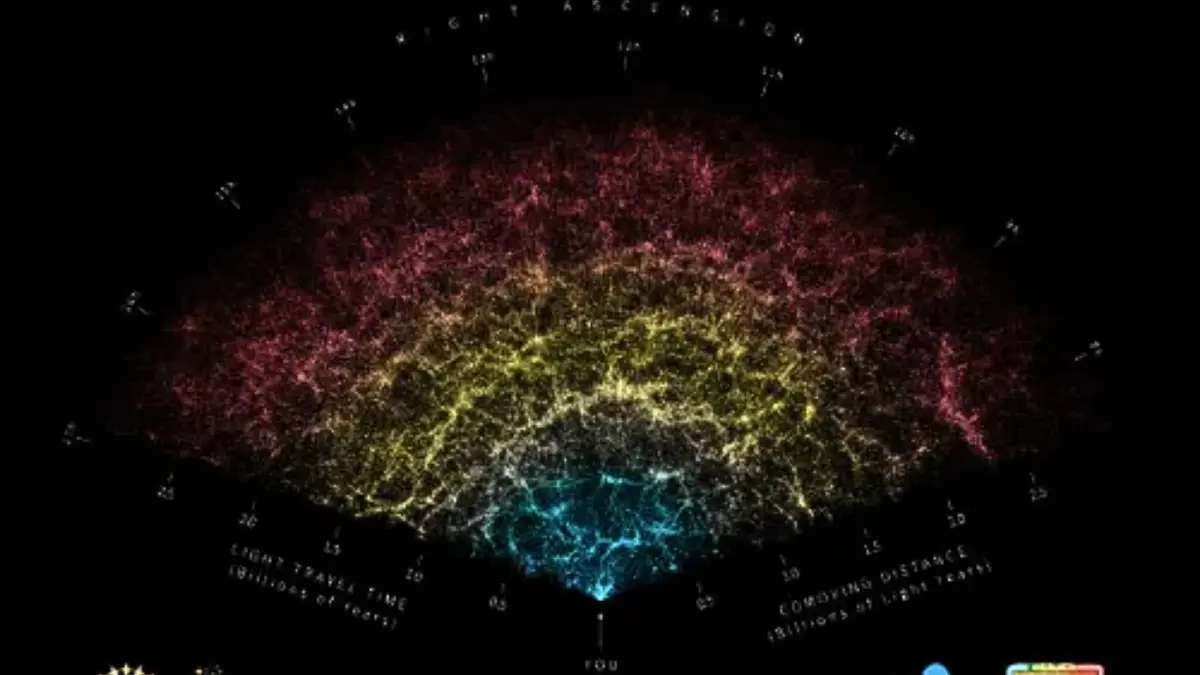
Arizona, April 19, 2026 — The Dark Energy Spectroscopic Instrument (DESI) has completed the largest high-resolution three-dimensional map of the universe, capturing data from more than 47 million galaxies and quasars and tracing cosmic structure across 11 billion years to study the force driving the universe’s accelerating expansion.
The milestone was reached after DESI’s 5,000 fiber-optic sensors completed their final scheduled observations, marking the end of a five-year survey conducted at the Kitt Peak National Observatory. The project delivered significantly more data than originally planned and was completed ahead of schedule.
Survey captures 47 million galaxies and quasars
DESI began operations in May 2021 with a target of mapping 34 million galaxies and quasars. By the end of the survey, the instrument had observed over 47 million such objects, along with an additional 20 million stars, exceeding initial expectations by a wide margin.
The dataset represents a major increase in scale, containing cosmological information from six times as many galaxies and quasars as all previous surveys combined. This unprecedented volume of data provides a detailed view of the large-scale structure of the universe.
The map reveals the distribution of galaxies and quasars in three dimensions, with Earth positioned at the center of the observed regions. Light from the most distant objects in the dataset has traveled approximately 11 billion years to reach Earth, offering a direct window into the early universe.
Data traces dark energy across 11 billion years
Researchers are using the DESI dataset to study dark energy, which is estimated to make up roughly 70 percent of the universe and is responsible for its accelerating expansion. By comparing how galaxies were clustered in the past with their distribution today, scientists can track how this force has influenced cosmic evolution.
Analysis of the first three years of data suggested that dark energy, traditionally modeled as a constant, may vary over time. The completion of the full five-year dataset provides a larger and more precise foundation to test this possibility.
The outcome of these investigations could reshape understanding of the universe’s expansion and its long-term behavior, depending on the balance between matter and dark energy.
Global collaboration spans 70 institutions
The DESI project involves more than 900 researchers, including 300 doctoral students, from over 70 institutions worldwide. Key contributors include the University of Portsmouth, University College London, Durham University, and the U.S. Department of Energy’s Lawrence Berkeley National Laboratory.
The instrument is mounted at the Kitt Peak National Observatory in Arizona and is operated as part of an international effort to investigate fundamental questions in cosmology. The large-scale collaboration has enabled rapid data collection and processing on a global scale.
Researchers involved in the project emphasized the importance of the dataset for future studies, including investigations into neutrinos, the lightest known fundamental particles, and other aspects of cosmic structure.
Survey expands to 17,000 square degrees by 2028
Following completion of its initial objectives, DESI has begun extending its survey to cover more of the sky. The mapped area is expected to increase from 14,000 to 17,000 square degrees by 2028, representing about 40 percent of the entire sky, which spans more than 41,000 square degrees.
The expansion will include observations closer to the plane of the Milky Way, where dense star fields can obscure distant galaxies, as well as regions further south that require observations through thicker layers of Earth’s atmosphere.
In addition to expanding coverage, the survey will revisit previously mapped areas to observe fainter and more distant luminous red galaxies. These additional measurements are expected to create a denser and more detailed map of cosmic structure.
Next results expected in 2027
With data collection complete, researchers are now processing the full dataset. The first comprehensive results on dark energy from the five-year survey are expected to be released in 2027.
Meanwhile, ongoing analysis of the initial three years of observations continues to refine measurements of galaxy clustering and cosmic expansion. Additional studies based on these earlier datasets are expected later this year.
The DESI survey represents one of the most extensive observational efforts in cosmology, providing a detailed framework for understanding how the universe has evolved over billions of years and offering new data to test fundamental theories about its composition and expansion.