Dharmendra Pradhan Criticizes Stalin Over ‘Imposition’ Narrative, Calls It Attempt to Mask Failures
Union Minister Dharmendra Pradhan criticizes Tamil Nadu Chief Minister M K Stalin, calling the “imposition” narrative a tactic to cover political failures, intensifying political tensions.
 SANJANA DUTTA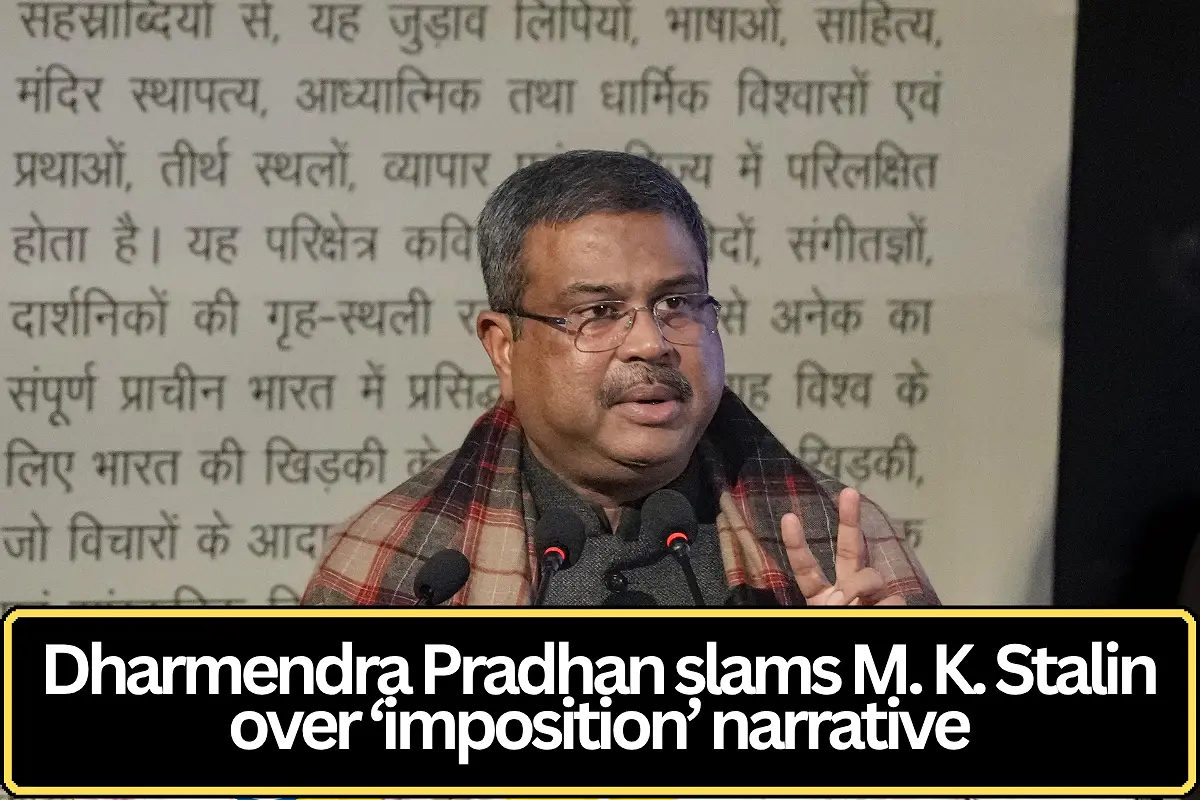
War of Words Intensifies Between Centre and Tamil Nadu Government
NEW DELHI, April 4, 2026 — Union Minister Dharmendra Pradhan on Saturday sharply criticized Tamil Nadu Chief Minister M K Stalin, accusing him of using the “imposition” narrative as a political tool to mask governance failures, escalating tensions between the Centre and the southern state government.
The remarks come amid an ongoing political debate over language policies and federal relations, with the ruling Dravida Munnetra Kazhagam (DMK) government in Tamil Nadu frequently alleging attempts by the Centre to impose Hindi and central policies on the state.
Pradhan’s Criticism of ‘Imposition’ Narrative
Pradhan dismissed the claims of imposition as a “tired attempt,” arguing that such rhetoric is being used to divert attention from administrative shortcomings. He asserted that the Centre’s policies are aimed at inclusive development and national integration, rather than enforcing cultural or linguistic dominance.
According to the Union Minister, repeated references to imposition are politically motivated and do not reflect the reality of governance. He maintained that the central government respects India’s linguistic diversity and is committed to cooperative federalism.
Pradhan further suggested that the Tamil Nadu government is attempting to create unnecessary controversy to mobilize political support, especially as regional dynamics continue to evolve.
Stalin Government’s Stand on Language and Federal Rights
The DMK-led government has consistently opposed what it perceives as efforts to promote Hindi at the expense of regional languages. Chief Minister Stalin has positioned himself as a strong advocate of state rights and linguistic identity, emphasizing the importance of preserving Tamil culture and autonomy.
State leaders have argued that policies related to education, administration, and communication should respect regional preferences and constitutional provisions. They have accused the Centre of overreach in certain areas, fueling political tensions.
The issue of language has historically been a sensitive and mobilizing factor in Tamil Nadu politics, often shaping electoral narratives and public discourse.
Political Context and Broader Implications
The exchange between Pradhan and Stalin reflects a broader pattern of friction between the Bharatiya Janata Party (BJP)-led central government and opposition-ruled states. Disagreements over policy implementation, resource allocation, and administrative autonomy have frequently led to public confrontations.
Analysts note that such disputes are often amplified by political messaging, with both sides seeking to reinforce their positions among their respective constituencies. The language debate, in particular, resonates strongly in Tamil Nadu, where historical movements have emphasized resistance to perceived cultural imposition.
At the national level, the BJP has sought to balance regional sensitivities with its broader agenda of integration and development, while opposition parties have emphasized federal principles and state autonomy.
Reactions from Political Circles
Pradhan’s remarks have drawn reactions from leaders across the political spectrum. BJP members have supported his stance, arguing that the Centre’s initiatives are being misrepresented for political gain. They have called for constructive dialogue and cooperation between the Centre and states.
On the other hand, DMK leaders and allies have rejected the criticism, reiterating their concerns about policy direction and the need to safeguard regional interests. They have accused the BJP of undermining federal values and ignoring local priorities.
The exchange has also sparked debate among political observers, with some highlighting the need for clearer communication and others emphasizing the importance of addressing underlying issues rather than engaging in rhetorical battles.
Language Politics and Historical Sensitivities
The debate over language policy is deeply rooted in Tamil Nadu’s political history, particularly the anti-Hindi agitations of the mid-20th century. These movements played a significant role in shaping the state’s political identity and continue to influence contemporary discourse.
Successive state governments have maintained a cautious approach toward language-related policies, prioritizing Tamil while resisting measures perceived as promoting Hindi dominance. This context adds complexity to current disputes and amplifies their political significance.
Experts suggest that any policy perceived as affecting linguistic balance is likely to trigger strong reactions in the state, making the issue a recurring flashpoint in Centre-state relations.
Impact on Governance and Public Perception
The ongoing political confrontation has implications for governance and public perception. While political debates are a normal part of democratic functioning, prolonged disputes can affect policy implementation and administrative coordination.
Observers note that maintaining a balance between political expression and effective governance is essential to ensure that public welfare is not compromised. Constructive engagement between the Centre and states is seen as key to addressing challenges and achieving development goals.
At the same time, political narratives play a crucial role in shaping voter perceptions, making such exchanges an integral part of the broader electoral landscape.
Calls for Dialogue and Cooperation
Amid the escalating rhetoric, there have been calls for dialogue and cooperation to resolve differences. Experts have emphasized the importance of respecting constitutional principles and fostering mutual understanding between different levels of government.
They have also highlighted the need for transparency in policy formulation and implementation, ensuring that concerns of all stakeholders are addressed. Building consensus on sensitive issues such as language policy is seen as essential for maintaining social harmony and political stability.
Both sides have been urged to move beyond confrontational approaches and focus on collaborative solutions that benefit citizens.
Conclusion
The sharp exchange between Dharmendra Pradhan and M K Stalin underscores the continuing tensions over language and federal issues in India’s political landscape.
Current Status
The debate remains ongoing, with both the Centre and the Tamil Nadu government holding firm to their positions as political rhetoric continues to intensify.