India-Made AI Healthcare Solutions Can Reform Global Models, Says Royal Philips CEO
Royal Philips CEO states that India-developed AI solutions in healthcare have the potential to reform global healthcare delivery models through innovation, scalability, and cost efficiency.
 Akanksha jain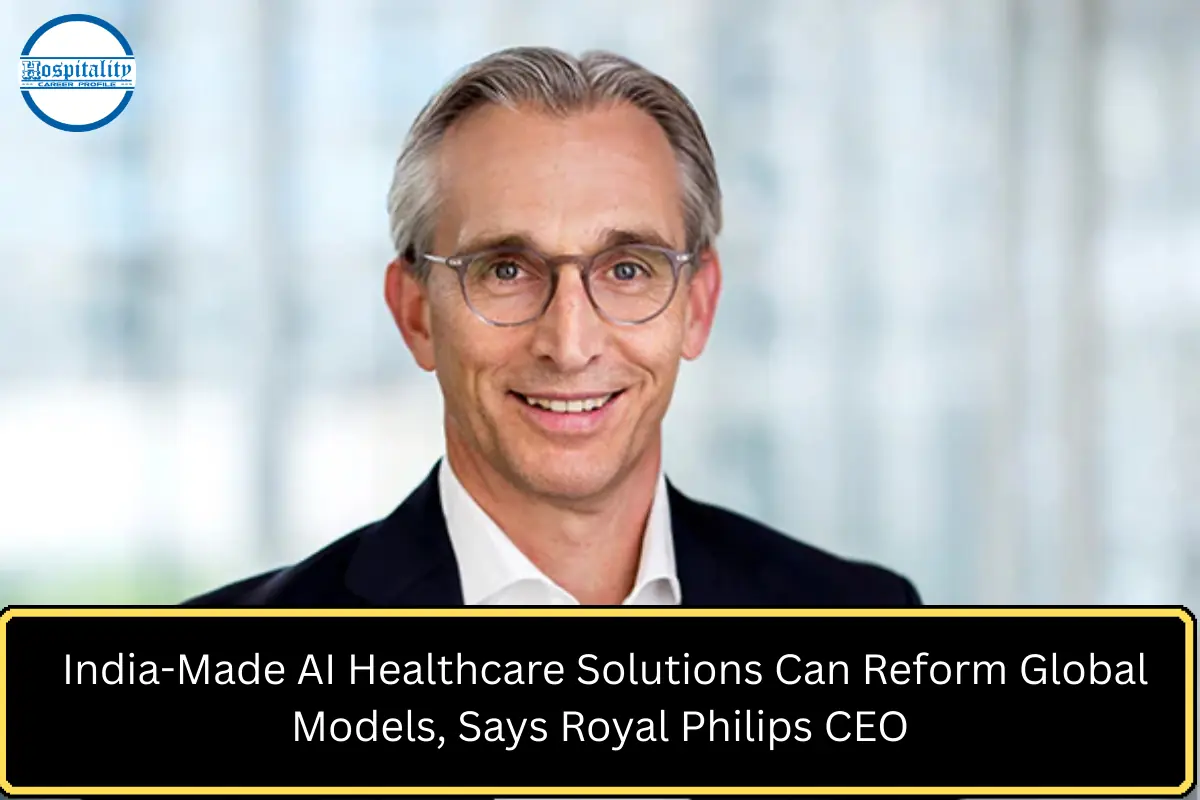
India-Made AI Healthcare Solutions Positioned to Influence Global Models
India-developed artificial intelligence (AI) solutions in healthcare have the potential to reshape global healthcare delivery systems, according to the CEO of Royal Philips. Highlighting India’s growing role in digital health innovation, the global healthcare technology leader emphasized that AI-driven solutions emerging from the country are scalable, cost-effective, and adaptable to diverse healthcare environments.
The statement underscores India’s increasing prominence as a hub for healthcare technology development, particularly in areas such as diagnostic imaging, predictive analytics, remote monitoring, and hospital workflow optimization.
India’s Growing Leadership in Healthcare AI
India has witnessed rapid growth in digital health infrastructure, supported by a strong technology ecosystem, skilled engineering talent, and a large patient base that enables real-world testing of scalable solutions. According to the Royal Philips CEO, these factors uniquely position India to create AI systems that address both domestic and international healthcare challenges.
AI applications developed in India are increasingly being integrated into clinical decision support systems, radiology workflows, and data-driven patient management tools. These solutions are designed to enhance diagnostic accuracy, reduce clinician workload, and improve operational efficiency.
Transforming Global Healthcare Delivery Models
Scalability and Affordability
One of the key strengths of India-made AI solutions lies in their ability to operate effectively in resource-constrained environments. The Royal Philips CEO noted that innovations designed for India’s diverse healthcare settings can be adapted for emerging markets and even advanced economies seeking cost optimization.
Affordable deployment models and cloud-based integration enable hospitals and clinics to implement AI systems without heavy infrastructure investments.
Improving Access to Care
AI-powered platforms can bridge gaps in healthcare access, particularly in rural and underserved areas. Telehealth integration, automated screening tools, and remote diagnostics supported by AI are expanding reach beyond traditional hospital settings.
By leveraging digital tools, healthcare providers can extend specialist expertise to remote locations, improving early detection and timely treatment.
Focus on Clinical Efficiency and Outcomes
The Royal Philips leadership highlighted that AI is not intended to replace clinicians but to augment their capabilities. Intelligent algorithms can analyze medical images, patient records, and diagnostic data more rapidly, allowing doctors to focus on complex decision-making and patient interaction.
AI-enabled triage systems and workflow management tools are also helping reduce bottlenecks in high-volume healthcare institutions. These improvements can enhance patient experience while maintaining high clinical standards.
Innovation Ecosystem Supporting Growth
India’s healthcare AI landscape benefits from collaboration between technology firms, healthcare providers, startups, and academic institutions. Government initiatives promoting digital health transformation have further accelerated innovation.
The Royal Philips CEO acknowledged that partnerships between global healthcare companies and Indian innovators are playing a crucial role in refining and scaling AI-based medical technologies.
Data-Driven Healthcare Future
With the increasing digitization of health records and diagnostic systems, data is becoming central to healthcare transformation. AI models trained on diverse datasets can generate predictive insights, support preventive care strategies, and personalize treatment pathways.
India’s large and varied population provides an extensive dataset environment that can enhance the robustness of AI algorithms, potentially benefiting global patient populations.
Ethical and Regulatory Considerations
While emphasizing AI’s transformative potential, the Royal Philips CEO also highlighted the importance of ethical governance, data privacy safeguards, and regulatory compliance. Responsible AI deployment must ensure transparency, patient consent, and accuracy in clinical applications.
Clear regulatory frameworks and global cooperation will be critical in ensuring that AI-driven healthcare innovations are both safe and effective.
India as a Global Healthcare Innovation Hub
The remarks reinforce India’s emergence as a strategic center for healthcare technology development. With increasing investments in research and development, along with expanding digital health infrastructure, India is positioned to contribute meaningfully to the evolution of global healthcare systems.
As AI continues to redefine medical diagnostics, hospital operations, and patient engagement, India-made solutions may serve as models for scalable and inclusive healthcare innovation worldwide.
Conclusion
The Royal Philips CEO’s statement reflects growing confidence in India’s capability to shape the future of healthcare through artificial intelligence. By combining technological expertise with real-world healthcare challenges, India is creating AI solutions that could influence global healthcare delivery frameworks.
If effectively implemented and governed, these innovations may contribute to more efficient, accessible, and sustainable healthcare systems across the world.