Kharge’s Remark on Deve Gowda Triggers Laughter in Rajya Sabha
Congress leader Mallikarjun Kharge’s humorous remark involving HD Deve Gowda and Prime Minister Narendra Modi sparked laughter in the Rajya Sabha during a parliamentary session.
 SANJANA DUTTA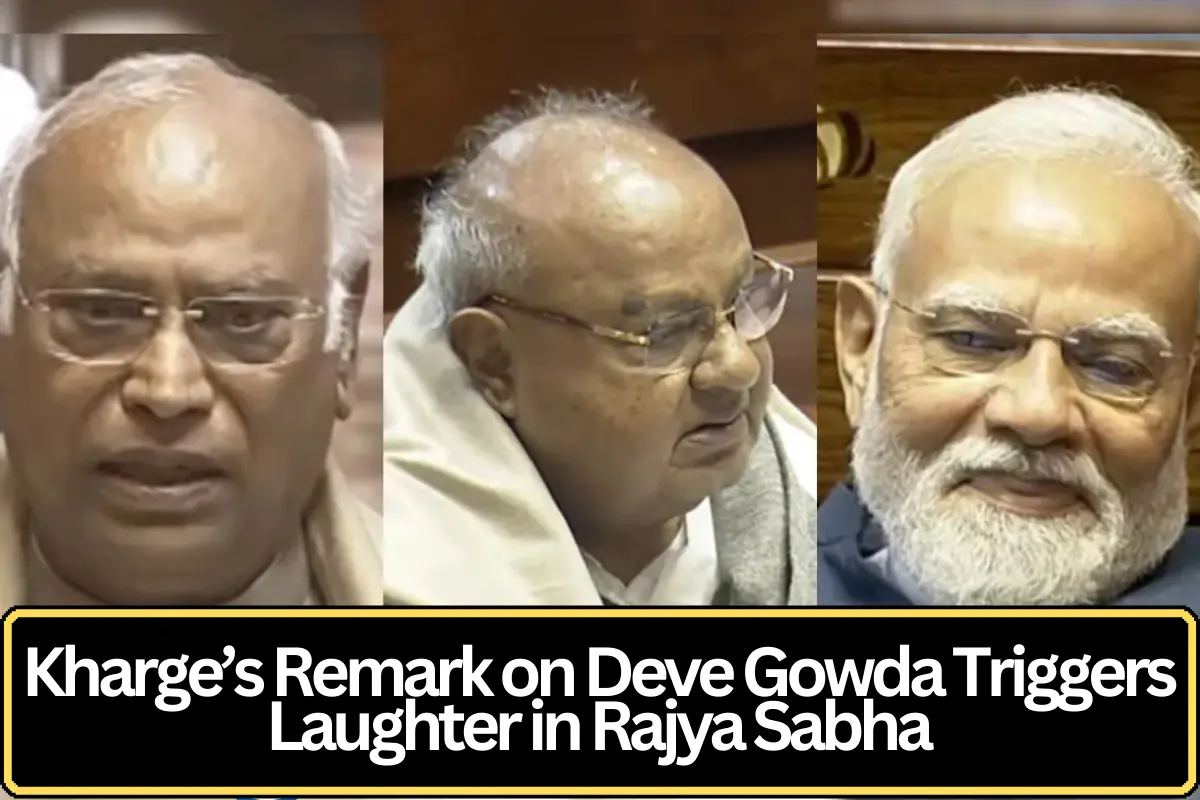
Light Moment in Rajya Sabha Amid Political Exchanges
A humorous remark by Congress president Mallikarjun Kharge involving former Prime Minister H D Deve Gowda and Prime Minister Narendra Modi sparked laughter in the Rajya Sabha, briefly easing tensions during an otherwise serious parliamentary session on March 18, 2026, in New Delhi.
Kharge made the comment while participating in a debate, drawing a playful comparison that elicited reactions from members across party lines. The remark quickly became a talking point, highlighting how moments of levity occasionally punctuate India’s often heated political discourse.
Context of the Remark
The exchange occurred during a discussion where Kharge was addressing political alliances and relationships between parties over time. In his speech, he referenced Deve Gowda in a lighthearted manner while mentioning Prime Minister Modi, leading to spontaneous laughter in the House.
Though the comment was made in jest, it reflected the complex and evolving nature of political alignments in India, where parties often shift positions based on changing electoral and strategic considerations.
Members from both the ruling and opposition benches were seen reacting positively, with the presiding officer also acknowledging the lighter moment before proceedings resumed.
Parliamentary Atmosphere and Debate
The Rajya Sabha session had been marked by intense discussions on key political and policy issues prior to the remark. Debates in the Upper House have recently seen sharp exchanges between the government and opposition over governance, economic policies, and electoral strategies.
Kharge’s intervention, while humorous, came amid broader arguments about political cooperation and ideological differences. His ability to inject humor into the debate was noted by observers as a reflection of parliamentary tradition, where wit and rhetoric often play a role in discussions.
Such moments can serve to diffuse tension and foster a more collegial atmosphere, even as disagreements persist on substantive issues.
Reactions from Political Leaders
Leaders across parties responded to the remark with amusement, underscoring the shared understanding of political humor within parliamentary culture. While the comment itself was not controversial, it drew attention for its timing and delivery.
Some members later commented informally that such exchanges help humanize political interactions, reminding participants and observers alike that debate need not always be adversarial.
However, political analysts also pointed out that humor in Parliament can carry underlying messages, subtly highlighting alliances, rivalries, and historical relationships between leaders and parties.
Role of Humor in Indian Politics
Humor has long been a feature of Indian parliamentary proceedings, with leaders using wit to make points more effectively or to engage their audience. From sharp one-liners to anecdotal references, such moments often become memorable highlights of debates.
In a highly competitive political environment, humor can serve multiple purposes—breaking monotony, easing tensions, and sometimes even delivering pointed criticism in a less confrontational manner.
Kharge’s remark fits into this tradition, demonstrating how seasoned politicians use rhetorical devices to connect with both colleagues and the public.
Broader Political Context
The reference to Deve Gowda and Modi also reflects the broader political landscape, where alliances and rivalries continue to evolve ahead of upcoming elections. Leaders frequently draw on past relationships and political history to frame current debates.
Deve Gowda, a veteran leader with decades of experience, remains a significant figure in discussions about coalition politics, while Modi continues to be a central figure in national political discourse.
By invoking both names in a humorous context, Kharge indirectly highlighted the interconnected nature of India’s political ecosystem.
Public and Media Attention
The moment quickly gained attention beyond Parliament, with clips and reports circulating widely across media platforms. Political observers and the public alike engaged with the remark, reflecting the enduring interest in parliamentary proceedings.
In an era of heightened political polarization, such lighter moments often resonate with audiences, offering a contrast to the usual tone of political debate.
Media coverage of the incident emphasized its humorous nature while also situating it within the broader context of ongoing political discussions.
Significance for Parliamentary Culture
The incident underscores the importance of maintaining a balance between गंभीर debate and constructive engagement in legislative bodies. While Parliament is primarily a forum for serious policymaking, moments of humor can contribute to a more inclusive and dynamic environment.
Such interactions also highlight the personal rapport that can exist between leaders, even when they represent opposing viewpoints. This aspect of parliamentary culture is often seen as essential for effective governance and dialogue.
Observers note that preserving this balance is crucial for ensuring that debates remain both substantive and accessible.
Outlook
As parliamentary sessions continue, similar moments of levity are likely to occur alongside intense debates on policy and politics. Leaders may continue to use humor strategically, both to engage audiences and to navigate complex discussions.
While the immediate impact of Kharge’s remark is limited to a brief moment of amusement, it contributes to the broader narrative of how political discourse unfolds in India’s लोकतांत्रिक institutions.
Current Status
Mallikarjun Kharge’s remark in the Rajya Sabha has drawn attention for its humor, providing a brief respite during ongoing parliamentary debates while reflecting the nuanced dynamics of Indian politics.