Korea Finance Minister Signals Market-Led Won-Dollar Rate as Currency Stabilises: Report
South Korea’s finance minister Koo Yoon-chul signals that the won-dollar exchange rate should align with market expectations as the currency stabilises near the 1,460 level.
 Tripti Srivastava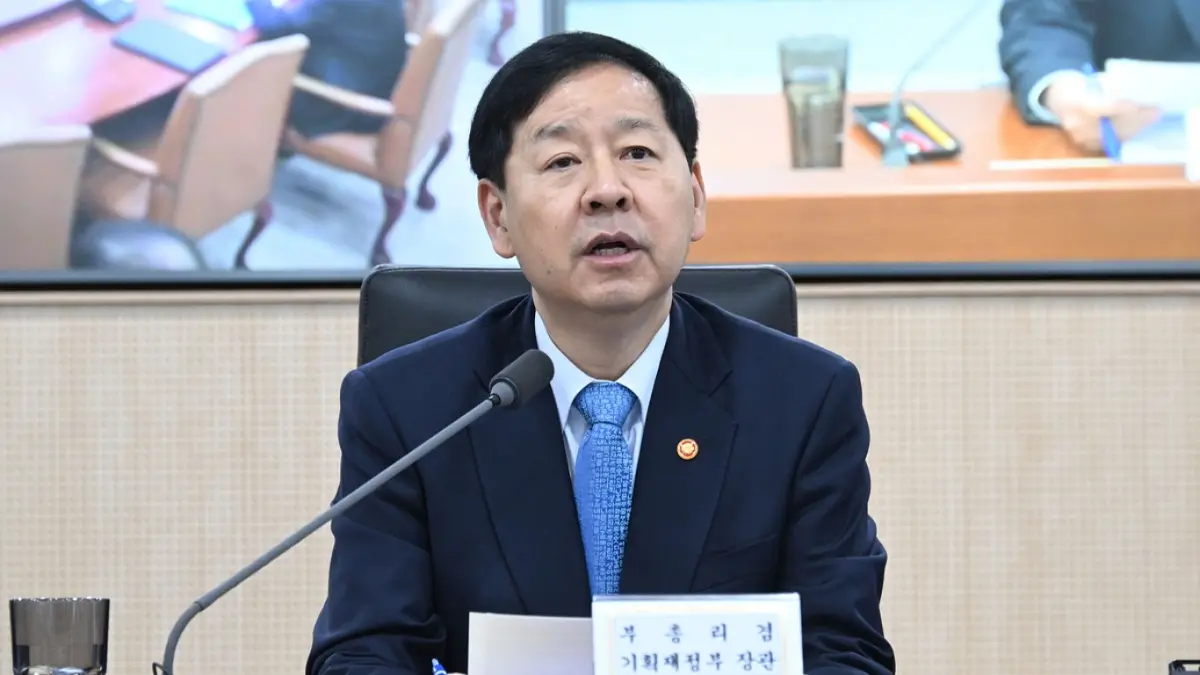
April 20, 2026: South Korea’s Deputy Prime Minister and Finance Minister Koo Yoon-chul indicated that the won-dollar exchange rate should move in line with market expectations, as the currency stabilised near the 1,460 level after recent volatility that had briefly pushed it above 1,500 amid geopolitical tensions.
The remarks come as the Korean won strengthened sharply following easing concerns around disruptions linked to tensions involving Iran. The currency had weakened significantly recently, reflecting heightened global uncertainty, before rebounding as conditions improved in key energy transit routes.
Exchange Rate Movement and Market Signals
The won-dollar exchange rate, which had crossed the 1,500 threshold during peak geopolitical stress, retreated to the 1,460 range by April 18, marking a decline of 14.6 won from the previous trading session. The reversal followed reports that Iran allowed passage through the Strait of Hormuz, easing supply concerns and stabilising financial markets.
Speaking on the sidelines of international meetings in the United States, Koo emphasised that exchange rate levels should reflect underlying market expectations rather than administrative targets. He noted that while Korea’s economic fundamentals provide a basis for currency valuation, it is ultimately market forces that determine the appropriate level.
He declined to provide a specific target for the exchange rate, stating that it would not be appropriate for policymakers to define a precise benchmark, reinforcing a market-driven approach to currency management.
The finance minister’s comments signal continuity in South Korea’s policy stance of allowing currency movements to be guided primarily by market dynamics, while maintaining readiness to respond to excessive volatility if required.
Koo highlighted that a combination of macroeconomic indicators, investor sentiment, and external developments shapes expectations around the exchange rate. He suggested that aligning with these expectations would contribute to overall market stability.
The government’s position reflects a broader strategy of balancing currency flexibility with financial stability, particularly in a global environment marked by shifting capital flows and geopolitical risks.
Global Engagement and Bilateral Discussions
The remarks were made during Koo’s visit to the United States, where he is attending the Group of 20 (G20) Finance Ministers' and Central Bank Governors’ Meeting, along with the International Monetary and Financial Committee (IMFC) discussions.
He indicated that exchange rate developments could be part of discussions in his bilateral meeting with U.S. Treasury Secretary Scott Besent, depending on the direction of talks. However, he suggested that the recent stabilisation of the currency may reduce the urgency of such discussions.
In addition to currency matters, the minister pointed to potential dialogue on investment cooperation between South Korea and the United States, based on previously agreed frameworks between the two countries’ leadership.
During his participation in a Group of Seven (G7) meeting focused on critical minerals, Koo underscored South Korea’s strategic role in global supply chains, particularly in smelting and refining capabilities.
He noted that while discussions did not extend to establishing a price floor system for critical minerals, there is growing momentum among international organisations to strengthen connections between supplier and consumer nations.
South Korea is expected to leverage its industrial strengths to deepen cooperation in this area, aligning with global efforts to secure supply chains for essential materials used in advanced technologies and energy transitions.
Market Context and Outlook
The recent volatility in the won-dollar exchange rate reflects broader global market dynamics influenced by geopolitical developments, particularly in energy-producing regions. Currency fluctuations have been closely tied to shifts in investor sentiment and changes in risk perception.
The stabilisation of the won near the 1,460 level suggests a partial recovery in confidence, although the markets remain sensitive to external shocks. Policymakers continue to monitor developments closely, with a focus on maintaining financial stability while allowing market mechanisms to function effectively.
South Korea’s approach underscores the importance of credible economic fundamentals and transparent policy communication in managing currency expectations during periods of global uncertainty.