Mars Study Finds ‘Bathtub Ring’ Hinting at Ancient Ocean
Scientists identify a “bathtub ring” feature on Mars suggesting a vast ancient ocean once covered its northern plains around 3.7 billion years ago.
 Shah Vaibhavi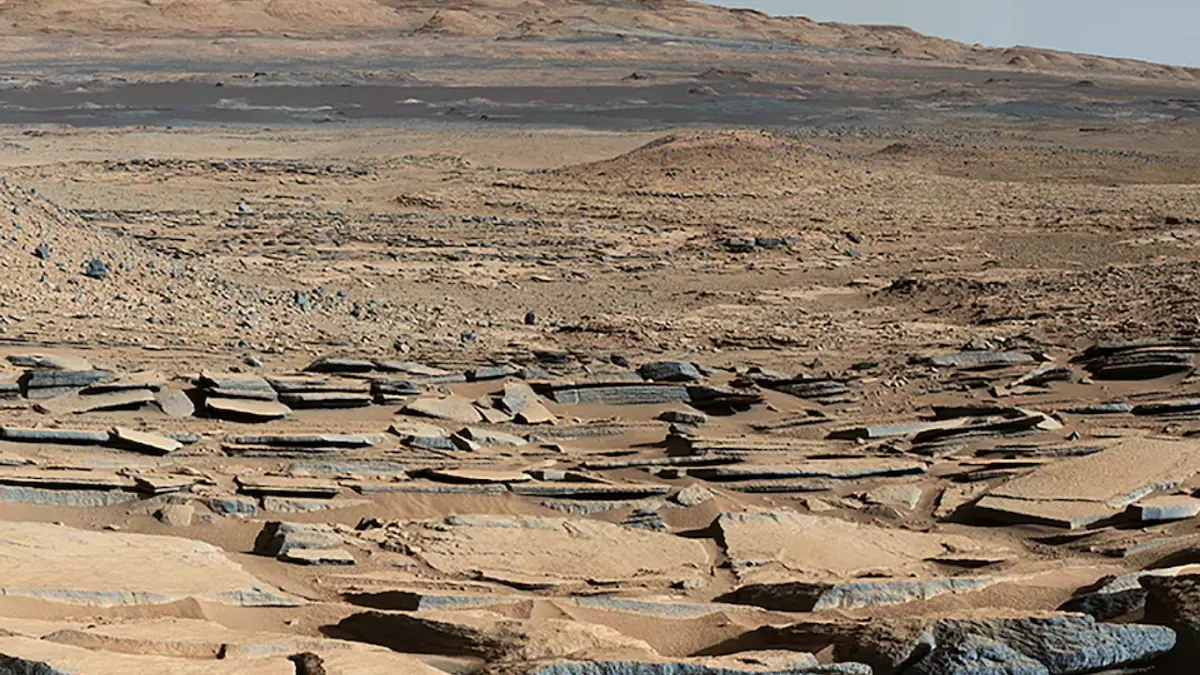
WASHINGTON, April 15, 2026 — Scientists have identified a large “bathtub ring”-like geological feature on Mars that may outline the boundary of an ancient ocean, offering new evidence that liquid water once covered vast portions of the planet’s northern plains about 3.7 billion years ago.
The finding, based on topographical data gathered by a NASA spacecraft that orbited Mars for a decade, provides one of the clearest indications yet of a long-debated ocean that may have existed early in the planet’s history. Researchers say the structure resembles a coastal shelf marking where water may once have met land.
Satellite data reveals possible ocean boundary
The study analyzed elevation data from NASA’s Mars Global Surveyor mission, identifying a continuous band of terrain consistent with ocean-like contours. This feature has been compared to a “bathtub ring,” a term used to describe residue left behind at the edge of standing water.
Unlike Earth, Mars lacks plate tectonics and continents, meaning any ocean-related features would not match terrestrial coastlines exactly. Instead, scientists describe the observed structure as a “coastal shelf,” formed by sediment accumulation at the boundary between land and water.
The researchers noted that the feature aligns with previously mapped regions believed to represent ancient shorelines, strengthening the case for a large, stable body of water.
Ocean may have covered one-third of planet
Earlier studies have suggested that a northern Martian ocean could have covered approximately one-third of the planet’s surface. This area is equivalent to about 13% of the total area of Earth’s oceans, indicating a substantial and potentially long-lived water body.
The ocean is believed to have existed during a period when Mars had a more active hydrological cycle, including rivers, lakes and flowing water systems. Scientists estimate this occurred roughly 3.7 billion years ago, when the planet’s climate was warmer and wetter than it is today.
Over time, Mars lost much of its atmosphere and surface water, transitioning into the cold and arid environment observed today. The fate of this water remains uncertain, with theories ranging from evaporation into space to storage beneath the surface.
Geological processes shaped coastal features
According to the study, the coastal shelf likely formed over millions of years as rivers transported sediment into the ocean. Wave activity and fluctuating sea levels would have redistributed these materials, creating layered geological structures similar to those found along Earth’s continental shelves.
If explored directly, scientists expect such regions to contain sedimentary rock formations, including sloped layers known as clinoforms and textures shaped by wave and current activity. These features could provide further confirmation of long-standing water interactions.
The presence of these formations would indicate sustained geological processes rather than short-lived or localized water events, supporting the hypothesis of a stable ocean.
Supporting evidence from rovers and radar
The findings build on multiple lines of evidence collected over recent years. Ground-penetrating radar data from China’s Zhurong rover previously detected buried structures interpreted as sandy beach deposits along an ancient shoreline.
In addition, scientists have identified numerous landforms resembling river deltas, where flowing water may have emptied into a larger body. These features are typically associated with persistent water systems and sediment deposition.
The newly identified coastal shelf appears in the same regions where these deltas and shoreline-like formations have been mapped, providing a more cohesive picture of Mars’ past environment.
Implications for habitability and research
The existence of a large ocean on Mars would have significant implications for understanding the planet’s potential to support life. Liquid water is considered a key requirement for habitability, and a widespread ocean would suggest that suitable conditions may have existed across large areas for extended periods.
However, researchers caution that evidence of water does not confirm the presence of life. Instead, it expands the range of environments that could have been capable of supporting biological processes.
Interpreting ancient Martian landscapes remains challenging due to billions of years of volcanic activity and wind erosion, which have altered surface features. Despite this, scientists say the combination of topographical, geological and radar data strengthens the case for a long-lived northern ocean.
The study adds to a growing body of research indicating that Mars once had conditions more similar to Earth, with active water systems shaping its surface. Further exploration, including potential rover missions to these regions, could provide more direct evidence of the planet’s watery past.