Study Uncovers ‘Pearling’ Mechanism That Regulates Mitochondrial DNA Spacing
Researchers have identified a ‘pearling’ mechanism that regulates mitochondrial DNA spacing, offering new insights into cellular function and disease.
 Akanksha jain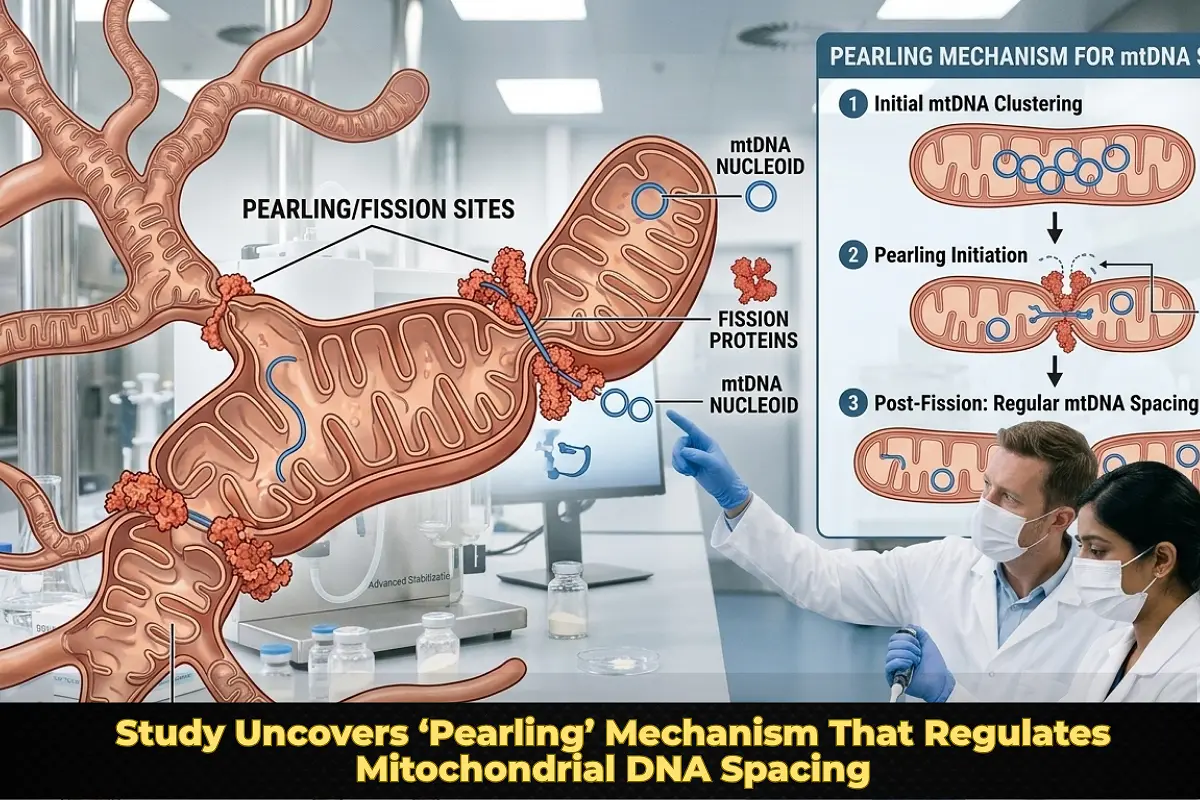
Study Uncovers ‘Pearling’ Mechanism That Regulates Mitochondrial DNA Spacing
Researchers have identified a previously unknown “pearling” mechanism that governs how mitochondrial DNA is spaced within cells, providing new insights into cellular organization and function, according to findings released in April 2026. The study, conducted by an international team of scientists, sheds light on how mitochondria maintain the proper distribution of genetic material essential for energy production and cellular health.
The discovery helps explain how mitochondrial DNA, which exists in multiple copies within each cell, is organized in a controlled and dynamic manner. Scientists say the findings could have implications for understanding a range of diseases linked to mitochondrial dysfunction, including metabolic and neurodegenerative disorders.
Understanding Mitochondrial DNA Organization
Mitochondria, often referred to as the powerhouses of the cell, are responsible for generating the energy required for various biological processes. Unlike most cellular components, mitochondria contain their own DNA, which is distinct from the DNA found in the cell nucleus.
This mitochondrial DNA is distributed throughout the mitochondrial network in small clusters known as nucleoids. Proper spacing and organization of these nucleoids are critical for ensuring efficient energy production and maintaining cellular health.
Until now, the mechanisms controlling how mitochondrial DNA is spaced and distributed remained poorly understood.
The ‘Pearling’ Phenomenon Explained
The newly identified mechanism, described as “pearling,” refers to a process in which the mitochondrial membrane forms bead-like structures along its length, resembling a string of pearls. These structures help regulate the positioning and spacing of mitochondrial DNA within the organelle.
Researchers observed that this pearling behavior is driven by physical forces within the mitochondrial membrane, which influence how DNA clusters are arranged. The process appears to be dynamic, allowing mitochondria to adapt their internal organization in response to changing cellular conditions.
This discovery highlights the role of mechanical forces in cellular organization, adding a new dimension to the understanding of mitochondrial biology.
Advanced Imaging Techniques Enable Discovery
The research team used advanced imaging technologies to observe mitochondrial structures in unprecedented detail. High-resolution microscopy allowed scientists to track the movement and arrangement of mitochondrial DNA in living cells.
By combining imaging with computational modeling, the researchers were able to identify patterns consistent with the pearling phenomenon. These techniques provided insights into how physical and biological factors interact to shape mitochondrial organization.
The use of cutting-edge tools was critical in uncovering a mechanism that had previously gone undetected.
Implications for Cellular Function
The spacing of mitochondrial DNA plays a key role in ensuring that energy production is evenly distributed throughout the cell. Disruptions in this organization can lead to inefficiencies in energy generation and contribute to cellular dysfunction.
The pearling mechanism appears to help maintain optimal spacing, ensuring that mitochondrial DNA is neither too clustered nor too dispersed. This balance is essential for maintaining stable cellular operations.
Researchers believe that understanding this mechanism could lead to new insights into how cells regulate energy production under different conditions.
Links to Disease and Health
Mitochondrial dysfunction has been linked to a wide range of diseases, including neurodegenerative disorders, cardiovascular conditions, and metabolic syndromes. Abnormalities in mitochondrial DNA distribution may play a role in these conditions.
The discovery of the pearling mechanism provides a potential explanation for how disruptions in mitochondrial structure could contribute to disease. If the process is impaired, it could lead to uneven DNA distribution and compromised cellular function.
Further research may explore whether targeting this mechanism could offer new therapeutic approaches for treating mitochondrial-related diseases.
Broader Impact on Cell Biology
The findings contribute to a growing body of research highlighting the importance of physical forces in biological systems. Traditionally, cellular organization has been studied primarily in terms of biochemical processes, but this study underscores the role of mechanical dynamics.
The concept of pearling may also apply to other cellular structures, suggesting that similar mechanisms could be involved in organizing different types of biological materials within cells.
Scientists say the research opens new avenues for exploring how physical principles influence cellular architecture and function.
Future Research Directions
While the study provides important insights, researchers emphasize that further investigation is needed to fully understand the pearling mechanism and its implications. Future studies may examine how the process is regulated and how it interacts with other cellular systems.
Scientists are also interested in exploring how environmental factors, such as stress or disease, affect mitochondrial pearling and DNA distribution. Understanding these interactions could provide valuable information for developing new treatments.
Advances in imaging and modeling technologies are expected to play a key role in advancing this area of research.
Potential Applications in Medicine
The ability to better understand and potentially control mitochondrial DNA organization could have significant implications for medicine. Therapies aimed at restoring proper mitochondrial function may benefit from insights gained through this research.
In addition, the findings could inform the development of diagnostic tools that detect early signs of mitochondrial dysfunction by analyzing DNA distribution patterns.
Researchers note that translating these findings into clinical applications will require extensive validation and collaboration across scientific disciplines.
Conclusion
The discovery of the pearling mechanism behind mitochondrial DNA spacing marks a significant advancement in cell biology, offering new insights into how cells organize their internal structures and maintain proper function.