Overnight Machine Perfusion Enables Safer Daytime Liver Transplants, Study Finds
A new study shows overnight machine perfusion can preserve donor livers safely, enabling daytime transplants and improving surgical outcomes and logistics.
 Akanksha jain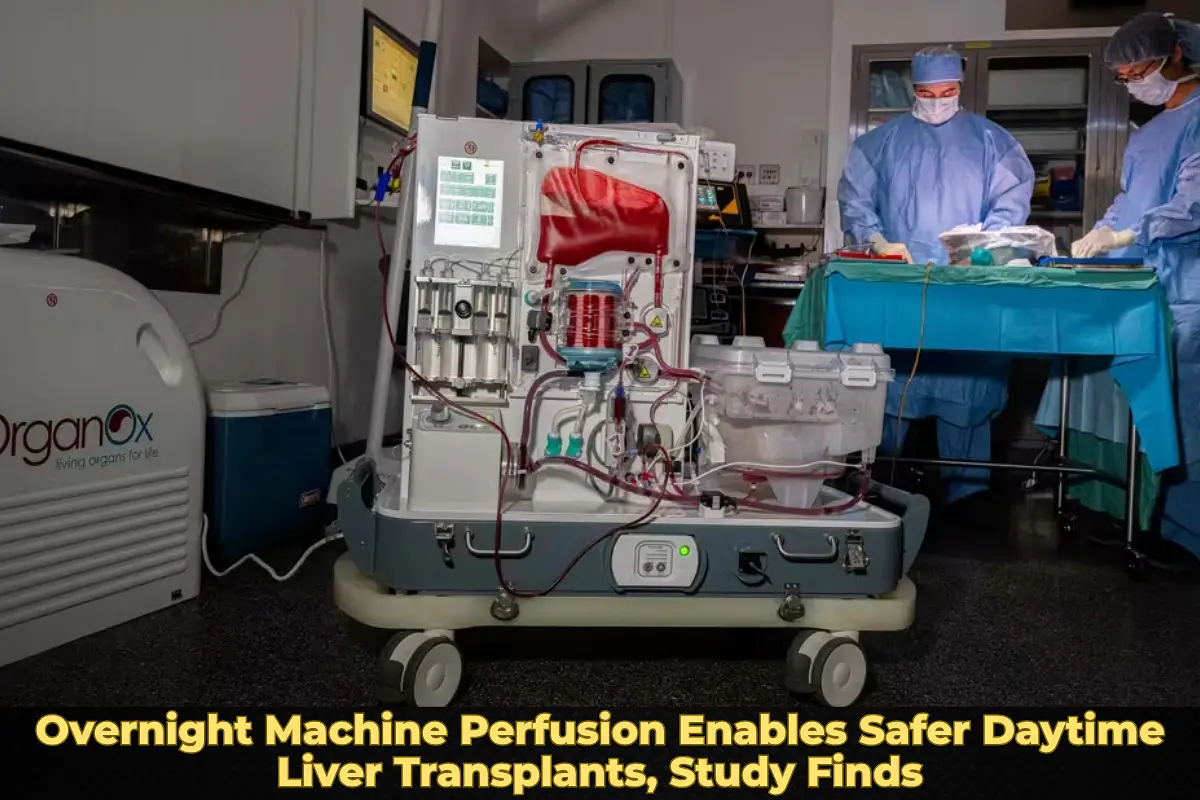
Overnight Machine Perfusion Enables Safer Daytime Liver Transplants, Study Finds
A new study released in April 2026 has found that overnight machine perfusion technology allows donor livers to be safely preserved for extended periods, enabling transplant surgeries to be performed during daytime hours instead of overnight emergencies. The research, conducted by an international team of transplant specialists, highlights how this innovation could improve patient outcomes, surgical efficiency, and hospital workflows.
Liver transplantation is a life-saving procedure for patients with end-stage liver disease, but it has traditionally been constrained by tight time windows. Donor organs must be transplanted quickly after retrieval, often requiring surgeries to take place at night under time pressure. The introduction of machine perfusion technology offers a new approach by maintaining organ viability for longer durations outside the body.
Transforming Organ Preservation
Machine perfusion involves circulating a specially formulated solution through the donor liver, supplying oxygen and nutrients while removing waste products. This process mimics natural physiological conditions, keeping the organ functional and reducing the risk of damage that can occur during static cold storage, the conventional preservation method.
The study demonstrated that livers preserved using overnight machine perfusion remained viable and functionally stable, allowing surgeons to delay transplantation until daytime hours without compromising safety or effectiveness.
Researchers emphasized that this shift could significantly reduce the logistical challenges associated with organ transplantation, where timing has historically been a critical limiting factor.
Benefits of Daytime Transplant Surgery
Performing liver transplants during the day offers several advantages for both patients and healthcare providers. Daytime procedures allow for better staffing, improved access to full surgical teams, and enhanced availability of support services such as imaging and laboratory diagnostics.
Surgeons participating in the study noted that operating under less time pressure and during standard working hours can lead to improved decision-making and reduced fatigue among medical staff. This, in turn, may contribute to better surgical outcomes and fewer complications.
Patients may also benefit from more coordinated care, as postoperative monitoring and support services are typically more accessible during the day.
Key Findings from the Study
The research found that overnight machine perfusion effectively preserved liver quality and function, with no significant increase in complications compared to traditional methods. In some cases, the technology even improved organ assessment by allowing clinicians to evaluate liver performance before transplantation.
This ability to assess organ viability in real time provides an additional layer of safety, helping clinicians make more informed decisions about whether a liver is suitable for transplantation.
The study also reported that the use of machine perfusion could expand the pool of usable donor organs by enabling the recovery and evaluation of marginal livers that might otherwise be discarded.
Improving Organ Utilization
One of the major challenges in transplantation is the shortage of donor organs. Many potentially viable livers are not used due to concerns about quality or preservation limitations. Machine perfusion technology offers a way to address this issue by extending preservation time and improving organ assessment.
By increasing the number of usable organs, this approach could help reduce waiting times for patients in need of transplants. It may also improve equity in access to transplantation by making better use of available resources.
Experts believe that wider adoption of this technology could have a significant impact on transplant systems worldwide.
Operational and System-Level Impact
Beyond clinical benefits, the shift to daytime transplantation could improve hospital operations and resource management. Night-time surgeries often require additional staffing and can strain healthcare systems, particularly in high-volume transplant centers.
Daytime scheduling allows for more predictable workflows, better coordination among medical teams, and more efficient use of operating rooms. This could lead to cost savings and improved overall efficiency in transplant programs.
Healthcare administrators highlighted that reducing the need for emergency overnight procedures could also improve staff well-being and reduce burnout.
Challenges and Future Adoption
Despite its promise, the implementation of machine perfusion technology may face challenges, including the cost of equipment and the need for specialized training. Hospitals will need to invest in infrastructure and develop protocols to integrate the technology into existing transplant workflows.
Researchers noted that further studies are needed to confirm long-term outcomes and assess the cost-effectiveness of widespread adoption. However, early results suggest that the benefits may outweigh the initial investment.
Regulatory approvals and standardization of practices will also play a role in determining how quickly the technology can be adopted globally.
Advancing Transplant Medicine
The findings represent a significant advancement in the field of transplant medicine, where improving organ preservation has long been a priority. Machine perfusion is part of a broader trend toward using technology to enhance the safety and effectiveness of complex medical procedures.
Researchers are exploring similar approaches for other organs, including kidneys, hearts, and lungs, with the aim of improving outcomes across the spectrum of transplantation.
The ability to extend preservation times and improve organ quality could transform how transplants are performed, making them more accessible and reliable.
Conclusion
The study demonstrates that overnight machine perfusion can safely enable daytime liver transplants, offering a promising solution to longstanding challenges in organ preservation and surgical scheduling while paving the way for broader innovations in transplant care.