India Holds Strategic Silence on Iran War as Energy, Trade and Diaspora Risks Mount
India maintains a cautious diplomatic silence on the Iran war while balancing energy security, Gulf trade, diaspora safety and global strategic interests.
 mansi labhde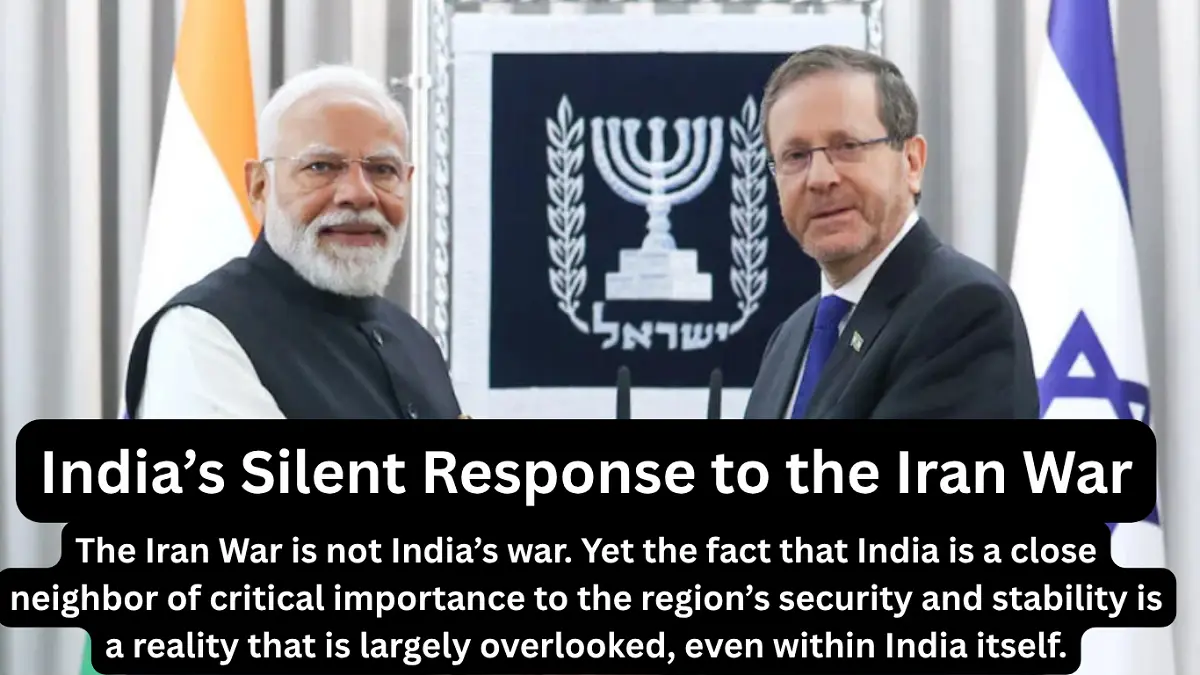
NEW DELHI, April 10, 2026 — India has maintained a cautious and largely silent diplomatic stance since the outbreak of the Iran war on February 28, opting to balance its strategic, economic, and geopolitical interests while avoiding direct condemnation of any involved parties.
The approach reflects New Delhi’s attempt to preserve diplomatic flexibility as the conflict involving Iran, the United States, and Israel intensifies, with significant implications for India’s energy security, trade routes, and diaspora in the Middle East.
Neutral Diplomacy Amid Escalating Conflict
India has refrained from publicly criticising military actions by either side in the conflict, instead maintaining communication channels with all key stakeholders, including Iran, the United States, Israel, and Gulf countries. The government supported a United Nations Security Council draft resolution condemning Iranian attacks on Gulf states but did not issue direct statements against US or Israeli actions.
Officials have indicated that maintaining engagement with all parties remains a priority, as India seeks to avoid taking a position that could jeopardise its strategic relationships across competing global blocs.
This policy mirrors India’s earlier stance in international conflicts, where it has emphasised dialogue and stability over public alignment.
Energy Security and Economic Exposure
India’s economic vulnerability in the ongoing conflict is closely tied to its dependence on the Strait of Hormuz, a critical maritime route. Approximately 90 percent of India’s liquefied petroleum gas imports and nearly 50 percent of its crude oil imports pass through the strait.
Additionally, about 14 percent of India’s exports to Gulf countries transit through this route, underlining the broader economic stakes involved. The conflict has already contributed to rising fuel prices and increased pressure on the Indian rupee.
The Indian diaspora in the Middle East represents another major concern. Nearly 10 million Indian nationals are employed in Gulf countries, and remittances from the region account for roughly 40 percent of India’s total inflows. Any escalation affecting employment or triggering large-scale repatriation could have economic and political consequences, particularly with multiple elections scheduled across Indian states.
Strategic Balancing Across Alliances
India’s diplomatic positioning has been shaped by its relationships with both Western powers and regional actors. Prime Minister Narendra Modi’s visit to Israel on February 25–26, shortly before the conflict began, elevated bilateral ties to a strategic partnership and included expressions of strong support.
However, following the outbreak of hostilities, India adopted a restrained public posture, limiting official statements and avoiding overt political messaging. Reports indicate that the Ministry of External Affairs exercised caution in diplomatic gestures, including restricting public condolence messages without prior approval.
This calibrated response highlights India’s effort to maintain access and credibility with all sides while managing perceptions of alignment.
Long-Term Stakes in Iran and Regional Connectivity
Iran remains strategically important for India beyond immediate economic considerations. It serves as a key link in India’s connectivity ambitions, particularly through the International North-South Transport Corridor and the Chabahar port project.
India has invested more than $120 million in infrastructure related to Chabahar, viewing it as a gateway to Central Asia that bypasses Pakistan. However, the conflict and ongoing sanctions pressures have strained aspects of this partnership, including reduced oil imports and scaled-back investments.
The evolving situation places India in a complex position, as it seeks to safeguard long-term strategic projects while maintaining relations with Western allies and Gulf partners.
Global Role and BRICS Dynamics
India’s stance is also being assessed in light of its presidency of BRICS, a grouping that includes Iran alongside China, Russia, and South Africa. The bloc has positioned itself as an alternative to Western-led financial and political systems.
India’s cautious approach, however, contrasts with the positions of some other BRICS members, raising questions about coherence within the group and the country’s role in advancing a multipolar global order.
Despite its status as one of the world’s largest economies and a major energy consumer, India’s limited public engagement in the crisis has highlighted the constraints it faces in influencing outcomes in high-intensity geopolitical conflicts.
As the war continues, India’s strategy remains focused on managing risks through quiet diplomacy, prioritising long-term interests while navigating a rapidly evolving international landscape.