Starmer Plans Law to Align UK with EU Rules Without Full Votes
UK Prime Minister Keir Starmer plans legislation allowing alignment with EU rules via secondary laws, sparking opposition over reduced parliamentary scrutiny.
 mansi labhde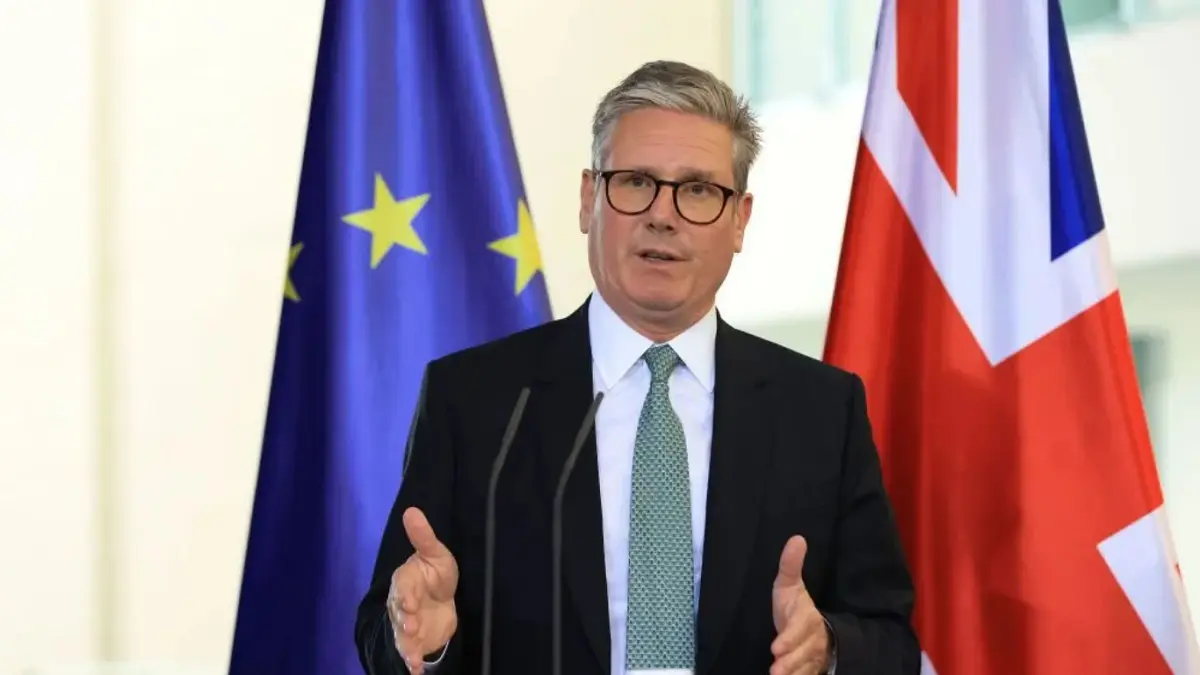
LONDON, April 2026 — :Sir Keir Starmer is preparing new legislation that would allow the United Kingdom to adopt future European Union rules through a streamlined process without requiring full parliamentary votes, as part of efforts to strengthen trade ties and align with EU standards in key sectors.
The proposed law, expected later this year, would enable ministers to introduce regulatory changes using secondary legislation, a faster mechanism that limits parliamentary scrutiny compared to primary legislation. The move is designed to facilitate “dynamic alignment” with EU rules in areas such as food standards, carbon pricing, and electricity trading.
Fast-Track Mechanism for EU Rule Alignment
Under the plan, the government would gain powers to implement new EU-aligned regulations through draft laws that do not require extensive debate or approval procedures in Parliament. This would allow quicker adaptation to evolving European standards, particularly in sectors linked to trade agreements under negotiation with the EU.
Officials say the mechanism is essential for delivering planned agreements, including a food standards deal expected to reduce regulatory barriers for exporters. The government has indicated such arrangements could generate significant economic benefits by simplifying cross-border trade.
The approach mirrors pre-Brexit practices, when the UK routinely incorporated EU legislation into domestic law. However, unlike before, the UK no longer has voting rights or direct influence over the formulation of those rules.
Limited Parliamentary Oversight Raises Concerns
The use of secondary legislation has sparked criticism due to its reduced scrutiny. While ministers insist that MPs and peers will retain a role in reviewing measures, the process typically allows less debate and fewer opportunities for amendment.
The issue is compounded by the recent abolition of a dedicated House of Commons committee that previously examined EU legislation, raising questions about how oversight will function under the new system.
Opposition figures argue the changes risk weakening parliamentary authority. Sir Keir Starmer, the Conservative shadow business secretary, said the proposal would leave Parliament sidelined while regulatory decisions are effectively shaped in Brussels.
Similarly, leader of Reform UK, pledged to oppose the legislation, describing it as an attempt to bring the UK back under EU influence through indirect means.
The Liberal Democrats expressed support for closer EU relations but warned that bypassing Parliament in the process would be undemocratic.
Trade Deals and Economic Rationale
The government has framed the proposal as a practical step to support economic growth and reduce costs. A planned agreement on food standards would require the UK to align with EU rules on areas including animal health, food additives, and labelling requirements.
Ministers also intend to pursue alignment with EU carbon trading rules as part of a broader agreement linking emissions systems. While details of the carbon market arrangement remain under discussion, it is expected to involve adopting regulatory frameworks governing the trading of carbon allowances.
These initiatives are part of a wider strategy to ease trade friction and improve market access following Brexit, particularly in sectors where regulatory divergence has created barriers for UK exporters.
Geopolitical Context and EU Relations
Starmer has linked the push for closer EU alignment to global instability, including the ongoing Iran conflict. He has argued that stronger economic and political ties with Europe are in the UK’s national interest amid rising uncertainty.
In public remarks, the prime minister emphasised that simplifying trade processes could help lower prices for consumers and support economic resilience during volatile global conditions.
The UK government is expected to advance negotiations with the EU ahead of a planned summit later this year, where agreements on food standards and carbon trading could be formally announced.
Political Divisions Over Post-Brexit Direction
The proposed legislation highlights ongoing divisions within UK politics over the country’s post-Brexit relationship with the EU. While the government views regulatory alignment as a pragmatic tool for economic cooperation, critics see it as a step away from regulatory independence.
The debate also reflects broader tensions between efficiency in policymaking and democratic oversight, with concerns that faster legislative processes may reduce transparency and accountability.
As the legislation moves forward, it is expected to face significant scrutiny in Parliament, with opposition parties preparing to challenge both its constitutional implications and its impact on the UK’s sovereignty over lawmaking.
The outcome of this proposal will play a key role in shaping the UK’s future engagement with the EU and its approach to balancing economic integration with political autonomy.